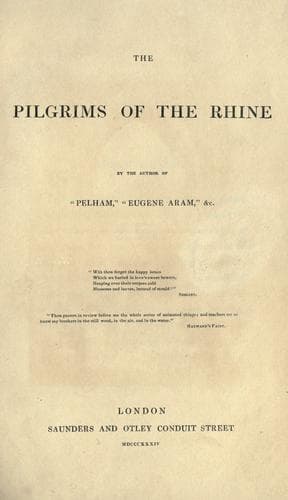
The Pilgrims of the RhineLytton, Edward Bulwer Lytton, Baron
Science
The Pilgrims of the Rhine
Lytton, Edward Bulwer Lytton, Baron
Fairies -- Fiction; Fantasy fiction; Rhine River Valley -- Fiction
When the sun arose, one of his brethren relieved him of his charge over
the herd, and he went away, but not to his father’s home. Musingly he
plunged into the dark and leafless recesses of the winter forest; and
shaped out of his wild thoughts, more palpably and clearly, the outline
of his daring hope. While thus absorbed he heard a great noise in the
forest, and, fearful lest the hostile tribe of the Alrich might pierce
that way, he ascended one of the loftiest pine-trees, to whose perpetual
verdure the winter had not denied the shelter he sought; and, concealed
by its branches, he looked anxiously forth in the direction whence the
noise had proceeded. And IT came,--it came with a tramp and a crash, and
a crushing tread upon the crunched boughs and matted leaves that strewed
the soil; it came, it came,--the monster that the world now holds
no more,--the mighty Mammoth of the North! Slowly it moved its huge
strength along, and its burning eyes glittered through the gloomy shade;
its jaws, falling apart, showed the grinders with which it snapped
asunder the young oaks of the forest; and the vast tusks, which, curved
downward to the midst of its massive limbs, glistened white and ghastly,
curdling the blood of one destined hereafter to be the dreadest ruler of
the men of that distant age.
The livid eyes of the monster fastened on the form of the herdsman, even
amidst the thick darkness of the pine. It paused, it glared upon him;
its jaws opened, and a low deep sound, as of gathering thunder, seemed
to the son of Osslah as the knell of a dreadful grave. But after glaring
on him for some moments, it again, and calmly, pursued its terrible
way, crashing the boughs as it marched along, till the last sound of its
heavy tread died away upon his ear.*
* _The Critic_ will perceive that this sketch of the beast, whose
race has perished, is mainly intended to designate the remote
period of the world in which the tale is cast.
Ere yet, however, Morven summoned the courage to descend the tree,
he saw the shining of arms through the bare branches of the wood, and
presently a small band of the hostile Alrich came into sight. He was
perfectly hidden from them; and, listening as they passed him, he heard
one say to another,--
“The night covers all things; why attack them by day?”
And he who seemed the chief of the band, answered,--
“Right. To-night, when they sleep in their city, we will upon them. Lo!
they will be drenched in wine, and fall like sheep into our hands.”
“But where, O chief,” said a third of the band, “shall our men hide
during the day? for there are many hunters among the youth of the
Oestrich tribe, and they might see us in the forest unawares, and arm
their race against our coming.”
“I have prepared for that,” answered the chief. “Is not the dark
cavern of Oderlin at hand? Will it not shelter us from the eyes of the
victims?”
Then the men laughed, and, shouting, they went their way adown the
forest.
Public-domain text, read in full here on John Shaqi.
Reviews
Reviews
No reviews yet
Be the first to share your thoughts on this work.
Elsewhere in the archive
Join the Discussion
Join the discussion
Sign in to leave a comment or review.
Sign InorCreate an account