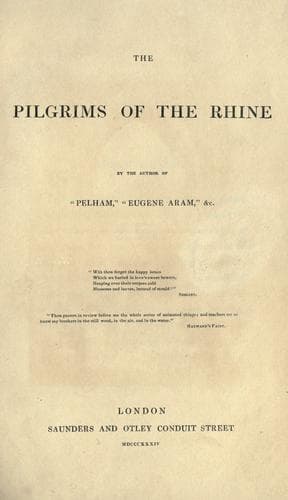
The Pilgrims of the RhineLytton, Edward Bulwer Lytton, Baron
Science
The Pilgrims of the Rhine
Lytton, Edward Bulwer Lytton, Baron
Fairies -- Fiction; Fantasy fiction; Rhine River Valley -- Fiction
When they were gone, Morven cautiously descended, and, striking into a
broad path, hastened to a vale that lay between the forest and the river
in which was the city where the chief of his country dwelt. As he passed
by the warlike men, giants in that day, who thronged the streets (if
streets they might be called), their half garments parting from their
huge limbs, the quiver at their backs, and the hunting spear in their
hand, they laughed and shouted out, and, pointing to him, cried, “Morven
the woman! Morven the cripple! what dost thou among men?”
For the son of Osslah was small in stature and of slender strength, and
his step had halted from his birth; but he passed through the warriors
unheedingly. At the outskirts of the city he came upon a tall pile in
which some old men dwelt by themselves, and counselled the king when
times of danger, or when the failure of the season, the famine or the
drought, perplexed the ruler, and clouded the savage fronts of his
warrior tribe.
They gave the counsels of experience, and when experience failed, they
drew, in their believing ignorance, assurances and omens from the winds
of heaven, the changes of the moon, and the flights of the wandering
birds. Filled--by the voices of the elements, and the variety of
mysteries, which ever shift along the face of things, unsolved by the
wonder which pauses not, the fear which believes, and that eternal
reasoning of all experience, which assigns causes to effect--with
the notion of superior powers, they assisted their ignorance by the
conjectures of their superstition. But as yet they knew no craft
and practised no _voluntary_ delusion; they trembled too much at the
mysteries which had created their faith to seek to belie them. They
counselled as they believed, and the bold dream of governing their
warriors and their kings by the wisdom of deceit had never dared to
cross men thus worn and gray with age.
The son of Osslah entered the vast pile with a fearless step, and
approached the place at the upper end of the hall where the old men sat
in conclave.
“How, base-born and craven-limbed!” cried the eldest, who had been
a noted warrior in his day, “darest thou enter unsummoned amidst the
secret councils of the wise men? Knowest thou not, scatterling! that the
penalty is death?”
Public-domain text, read in full here on John Shaqi.
Reviews
Reviews
No reviews yet
Be the first to share your thoughts on this work.
Elsewhere in the archive
Join the Discussion
Join the discussion
Sign in to leave a comment or review.
Sign InorCreate an account