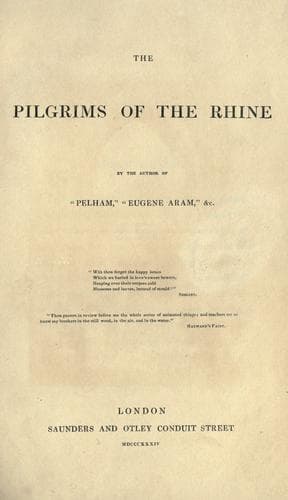
The Pilgrims of the RhineLytton, Edward Bulwer Lytton, Baron
Science
The Pilgrims of the Rhine
Lytton, Edward Bulwer Lytton, Baron
Fairies -- Fiction; Fantasy fiction; Rhine River Valley -- Fiction
I found, continued Trevylyan, that this tale was corroborated by inquiry
into the visionary’s habits. He shunned society; avoided all unnecessary
movement or excitement. He fared with rigid abstemiousness, and only
appeared to feel pleasure as the day departed, and the hour of return to
his imaginary kingdom approached. He always retired to rest punctually
at a certain hour, and would sleep so soundly that a cannon fired under
his window would not arouse him. He never, which may seem singular,
spoke or moved much in his sleep, but was peculiarly calm, almost to
the appearance of lifelessness; but, discovering once that he had been
watched in sleep, he was wont afterwards carefully to secure the chamber
from intrusion. His victory over the natural incoherence of sleep had,
when I first knew him, lasted for some years; possibly what imagination
first produced was afterwards continued by habit.
I saw him again a few months subsequent to this confession, and he
seemed to me much changed. His health was broken, and his abstraction
had deepened into gloom.
I questioned him of the cause of the alteration, and he answered me with
great reluctance,--
“She is dead,” said he; “my realms are desolate! A serpent stung her,
and she died in these very arms. Vainly, when I started from my sleep in
horror and despair, vainly did I say to myself,--This is but a dream. I
shall see her again. A vision cannot die! Hath it flesh that decays; is
it not a spirit,--bodiless, indissoluble? With what terrible anxiety
I awaited the night! Again I slept, and the DREAM lay again before me,
dead and withered. Even the ideal can vanish. I assisted in the burial;
I laid her in the earth; I heaped the monumental mockery over her form.
And never since hath she, or ought like her, revisited my dreams. I see
her only when I wake; thus to wake is indeed to dream! But,” continued
the visionary in a solemn voice, “I feel myself departing from this
world, and with a fearful joy; for I think there may be a land beyond
even the land of sleep where I shall see her again,--a land in which a
vision itself may be restored.”
And in truth, concluded Trevylyan, the dreamer died shortly afterwards,
suddenly, and in his sleep. And never before, perhaps, had Fate so
literally made of a living man (with his passions and his powers, his
ambition and his love) the plaything and puppet of a dream!
“Ah,” said Vane, who had heard the latter part of Trevylyan’s story,
“could the German have bequeathed to us his secret, what a refuge should
we possess from the ills of earth! The dungeon and disease, poverty,
affliction, shame, would cease to be the tyrants of our lot; and to
Sleep we should confine our history and transfer our emotions.”
“Gertrude,” whispered the lover, “what his kingdom and his bride were to
the Dreamer art thou to me!”
CHAPTER XXIV. THE BROTHERS.
Public-domain text, read in full here on John Shaqi.
Reviews
Reviews
No reviews yet
Be the first to share your thoughts on this work.
Elsewhere in the archive
Join the Discussion
Join the discussion
Sign in to leave a comment or review.
Sign InorCreate an account