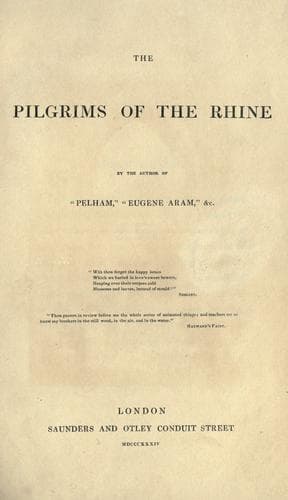
The Pilgrims of the RhineLytton, Edward Bulwer Lytton, Baron
Science
The Pilgrims of the Rhine
Lytton, Edward Bulwer Lytton, Baron
Fairies -- Fiction; Fantasy fiction; Rhine River Valley -- Fiction
THE banks of the Rhine now shelved away into sweeping plains, and on
their right rose the once imperial city of Boppart. In no journey
of similar length do you meet with such striking instances of the
mutability and shifts of power. To find, as in the Memphian Egypt, a
city sunk into a heap of desolate ruins; the hum, the roar, the mart of
nations, hushed into the silence of ancestral tombs, is less humbling
to our human vanity than to mark, as along the Rhine, the kingly city
dwindled into the humble town or the dreary village,--decay without its
grandeur, change without the awe of its solitude! On the site on
which Drusus raised his Roman tower, and the kings of the Franks their
palaces, trade now dribbles in tobacco-pipes, and transforms into an
excellent cotton factory the antique nunnery of Konigsberg! So be it; it
is the progressive order of things,--the world itself will soon be one
excellent cotton factory!
“Look,” said Trevylyan, as they sailed on, “at yonder mountain, with its
two traditionary Castles of Liebenstein and Sternfels.”
Massive and huge the ruins swelled above the green rock, at the foot
of which lay, in happier security from time and change, the clustered
cottages of the peasant, with a single spire rising above the quiet
village.
“Is there not, Albert, a celebrated legend attached to those castles?”
said Gertrude. “I think I remember to have heard their names in
connection with your profession of taleteller.”
“Yes,” said Trevylyan, “the story relates to the last lords of those
shattered towers, and--”
“You will sit here, nearer to me, and begin,” interrupted Gertrude, in
her tone of childlike command. “Come.”
THE BROTHERS.
A TALE.*
* This tale is, in reality, founded on the beautiful tradition
which belongs to Liebenstein and Sternfels.
You must imagine then, dear Gertrude (said Trevylyan), a beautiful
summer day, and by the same faculty that none possess so richly as
yourself, for it is you who can kindle something of that divine spark
even in me, you must rebuild those shattered towers in the pomp of old;
raise the gallery and the hall; man the battlements with warders, and
give the proud banners of ancestral chivalry to wave upon the walls. But
above, sloping half down the rock, you must fancy the hanging gardens of
Liebenstein, fragrant with flowers, and basking in the noonday sun.
On the greenest turf, underneath an oak, there sat three persons, in the
bloom of youth. Two of the three were brothers; the third was an orphan
girl, whom the lord of the opposite tower of Sternfels had bequeathed
to the protection of his brother, the chief of Liebenstein. The castle
itself and the demesne that belonged to it passed away from the female
line, and became the heritage of Otho, the orphan’s cousin, and the
younger of the two brothers now seated on the turf.
Public-domain text, read in full here on John Shaqi.
Reviews
Reviews
No reviews yet
Be the first to share your thoughts on this work.
Elsewhere in the archive
Join the Discussion
Join the discussion
Sign in to leave a comment or review.
Sign InorCreate an account