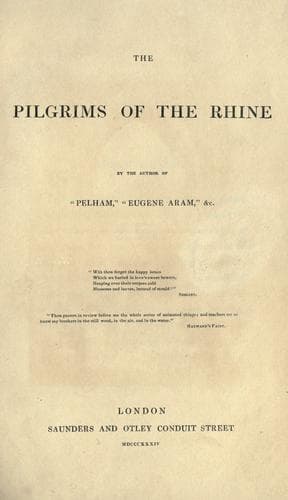
The Pilgrims of the RhineLytton, Edward Bulwer Lytton, Baron
Science
The Pilgrims of the Rhine
Lytton, Edward Bulwer Lytton, Baron
Fairies -- Fiction; Fantasy fiction; Rhine River Valley -- Fiction
“Was that thy fault?” said the Templar, gayly. “It may many times chance
to thee again to be preferred to another. Troth, it is a sin under which
the conscience may walk lightly enough. But sleep on it, Otho; my eyes
grow heavy.”
The next day Otho sought Leoline, and proposed to her that their wedding
should precede his parting; but so embarrassed was he, so divided
between two wishes, that Leoline, offended, hurt, stung by his coldness,
refused the proposal at once. She left him lest he should see her weep,
and then--then she repented even of her just pride!
But Otho, striving to appease his conscience with the belief that
hers now was the _sole_ fault, busied himself in preparations for his
departure. Anxious to outshine his brother, he departed not as Warbeck,
alone and unattended, but levying all the horse, men, and money that
his domain of Sternfels--which he had not yet tenanted--would afford, he
repaired to Frankfort at the head of a glittering troop.
The Templar, affecting a relapse, tarried behind, and promised to join
him at that Constantinople of which he had so loudly boasted. Meanwhile
he devoted his whole powers of pleasing to console the unhappy orphan.
The force of her simple love was, however, stronger than all his arts.
In vain he insinuated doubts of Otho,--she refused to hear them; in vain
he poured with the softest accents into her ear the witchery of flattery
and song,--she turned heedlessly away; and only pained by the courtesies
that had so little resemblance to Otho, she shut herself up in her
chamber, and pined in solitude for her forsaker.
The Templar now resolved to attempt darker arts to obtain power over
her, when, fortunately, he was summoned suddenly away by a mission from
the Grand Master of so high import, that it could not be resisted by a
passion stronger in his breast than love,--the passion of ambition. He
left the castle to its solitude; and Otho peopling it no more with his
gay companions, no solitude _could_ be more unfrequently disturbed.
Meanwhile, though, ever and anon, the fame of Warbeck reached their
ears, it came unaccompanied with that of Otho,--of him they had no
tidings; and thus the love of the tender orphan was kept alive by
the perpetual restlessness of fear. At length the old chief died, and
Leoline was left utterly alone.
One evening as she sat with her maidens in the hall, the ringing of a
steed’s hoofs was heard in the outer court; a horn sounded, the heavy
gates were unbarred, and a knight of a stately mien and covered with the
mantle of the Cross entered the hall. He stopped for one moment at the
entrance, as if overpowered by his emotion; in the next he had clasped
Leoline to his breast.
“Dost thou not recognize thy cousin Warbeck?” He doffed his casque, and
she saw that majestic brow which, unlike Otho’s, had never changed or
been clouded in its aspect to her.
Public-domain text, read in full here on John Shaqi.
Reviews
Reviews
No reviews yet
Be the first to share your thoughts on this work.
Elsewhere in the archive
Join the Discussion
Join the discussion
Sign in to leave a comment or review.
Sign InorCreate an account