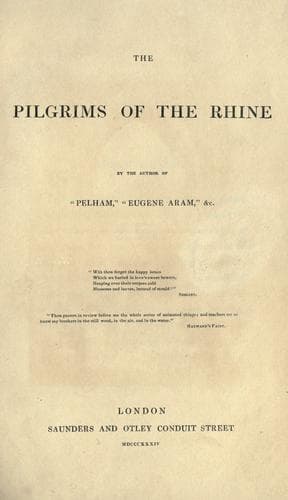
The Pilgrims of the RhineLytton, Edward Bulwer Lytton, Baron
Science
The Pilgrims of the Rhine
Lytton, Edward Bulwer Lytton, Baron
Fairies -- Fiction; Fantasy fiction; Rhine River Valley -- Fiction
“Paper,” said Nymphalin, who was still somewhat of a
_precieuse_,--“paper is a wonderful thing. What pretty books the human
people write upon it!”
“Ah! that’s what I design to convey,” said the silver king. “It is the
age less of paper money than paper government: the Press is the true
bank.” The lord treasurer of the English fairies pricked up his ears
at the word “bank;” for he was the Attwood of the fairies: he had a
favourite plan of making money out of bulrushes, and had written four
large bees’-wings full upon the true nature of capital.
While they were thus conversing, a sudden sound as of some rustic and
rude music broke along the air, and closing its wild burden, they heard
the following song:--
THE COMPLAINT OF THE LAST FAUN.
I. The moon on the Latmos mountain Her pining vigil keeps;
And ever the silver fountain In the Dorian valley weeps.
But gone are Endymion’s dreams; And the crystal lymph
Bewails the nymph
Whose beauty sleeked the streams!
II. Round Arcady’s oak its green The Bromian ivy weaves;
But no more is the satyr seen Laughing out from the glossy leaves.
Hushed is the Lycian lute, Still grows the seed
Of the Moenale reed,
But the pipe of Pan is mute!
III. The leaves in the noon-day quiver; The vines on the mountains wave;
And Tiber rolls his river As fresh by the Sylvan’s cave.
But my brothers are dead and gone; And far away
From their graves I stray,
And dream of the past alone!
IV. And the sun of the north is chill; And keen is the northern gale;
Alas for the Song of the Argive hill; And the dance in the Cretan vale!
The youth of the earth is o’er, And its breast is rife
With the teeming life
Of the golden Tribes no more!
V. My race are more blest than I, Asleep in their distant bed;
‘T were better, be sure, to die Than to mourn for the buried Dead:
To rove by the stranger streams, At dusk and dawn
A lonely faun,
The last of the Grecian’s dreams.
As the song ended a shadow crossed the moonlight, that lay white and
lustrous before the aperture of the cavern; and Nymphalin, looking up,
beheld a graceful yet grotesque figure standing on the sward without,
and gazing on the group in the cave. It was a shaggy form, with a goat’s
legs and ears; but the rest of its body, and the height of the stature,
like a man’s. An arch, pleasant, yet malicious smile played about its
lips; and in its hand it held the pastoral pipe of which poets have
sung,--they would find it difficult to sing to it!
“And who art thou?” said Fayzenheim, with the air of a hero.
Public-domain text, read in full here on John Shaqi.
Reviews
Reviews
No reviews yet
Be the first to share your thoughts on this work.
Elsewhere in the archive
Join the Discussion
Join the discussion
Sign in to leave a comment or review.
Sign InorCreate an account