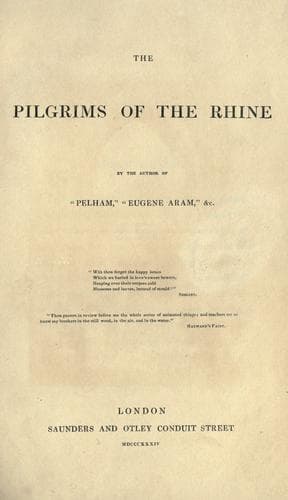
The Pilgrims of the RhineLytton, Edward Bulwer Lytton, Baron
Science
The Pilgrims of the Rhine
Lytton, Edward Bulwer Lytton, Baron
Fairies -- Fiction; Fantasy fiction; Rhine River Valley -- Fiction
“I am the last lingering wanderer of the race which the Romans
worshipped; hither I followed their victorious steps, and in these green
hollows have I remained. Sometimes in the still noon, when the leaves of
spring bud upon the whispering woods, I peer forth from my rocky lair,
and startle the peasant with my strange voice and stranger shape. Then
goes he home, and puzzles his thick brain with mopes and fancies, till
at length he imagines me, the creature of the South! one of his northern
demons, and his poets adapt the apparition to their barbarous lines.”
“Ho!” quoth the silver king, “surely thou art the origin of the fabled
Satan of the cowled men living whilom in yonder ruins, with its horns
and goatish limbs; and the harmless faun has been made the figuration
of the most implacable of fiends. But why, O wanderer of the South,
lingerest thou in these foreign dells? Why returnest thou not to the
bi-forked hill-top of old Parnassus, or the wastes around the yellow
course of the Tiber?”
“My brethren are no more,” said the poor faun; “and the very faith that
left us sacred and unharmed is departed. But here all the spirits not of
mortality are still honoured; and I wander, mourning for Silenus, though
amidst the vines that should console me for his loss.”
“Thou hast known great beings in thy day,” said the leaden king, who
loved the philosophy of a truism (and the history of whose inspirations
I shall one day write).
“Ah, yes,” said the faun; “my birth was amidst the freshness of the
world, when the flush of the universal life coloured all things with
divinity; when not a tree but had its Dryad, not a fountain that was
without its Nymph. I sat by the gray throne of Saturn, in his old age,
ere yet he was discrowned (for he was no visionary ideal, but the arch
monarch of the pastoral age), and heard from his lips the history of the
world’s birth. But those times are gone forever,--they have left harsh
successors.”
“It is the age of paper,” muttered the lord treasurer, shaking his head.
“What ho, for a dance!” cried Fayzenheim, too royal for moralities, and
he whirled the beautiful Nymphalin into a waltz. Then forth issued the
fairies, and out went the dwarfs. And the faun leaning against an aged
elm, ere yet the midnight waned, the elves danced their charmed round
to the antique minstrelsy of his pipe,--the minstrelsy of the Grecian
world!
“Hast thou seen yet, my Nymphalin,” said Fayzenheim, in the pauses of
the dance, “the recess of the Hartz, and the red form of its mighty
hunter?”
“It is a fearful sight,” answered Nymphalin; “but with thee I should not
fear.”
“Away then!” cried Fayzenheim; “let us away at the first cock-crow, into
those shaggy dells; for there is no need of night to conceal us, and the
unwitnessed blush of morn or the dreary silence of noon is, no less than
the moon’s reign, the season for the sports of the superhuman tribes.”
Public-domain text, read in full here on John Shaqi.
Reviews
Reviews
No reviews yet
Be the first to share your thoughts on this work.
Elsewhere in the archive
Join the Discussion
Join the discussion
Sign in to leave a comment or review.
Sign InorCreate an account