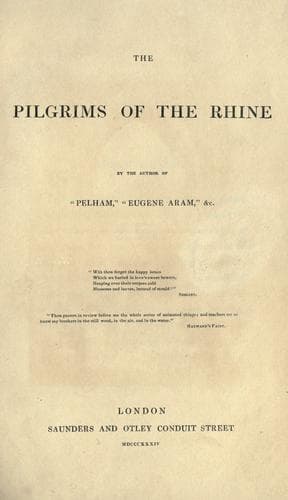
The Pilgrims of the RhineLytton, Edward Bulwer Lytton, Baron
Science
The Pilgrims of the Rhine
Lytton, Edward Bulwer Lytton, Baron
Fairies -- Fiction; Fantasy fiction; Rhine River Valley -- Fiction
Vane, who was an early riser, went forth alone in the morning to
reconnoitre the town; and as he was gazing on the tower of St. Peter,
he heard himself suddenly accosted. He turned round and saw the German
student whom they had met among the mountains of Taunus at his elbow.
“Monsieur has chosen well in coming hither,” said the student; “and I
trust our town will not disappoint his expectations.” Vane answered with
courtesy, and the German offering to accompany him in his walk, their
conversation fell naturally on the life of a university, and the current
education of the German people.
“It is surprising,” said the student, “that men are eternally inventing
new systems of education, and yet persevering in the old. How many
years ago is it since Fichte predicted in the system of Pestalozzi
the regeneration of the German people? What has it done? We admire, we
praise, and we blunder on in the very course Pestalozzi proves to
be erroneous. Certainly,” continued the student, “there must be some
radical defect in a system of culture in which genius is an exception,
and dulness the result. Yet here, in our German universities, everything
proves that education without equitable institutions avails little in
the general formation of character. Here the young men of the colleges
mix on the most equal terms; they are daring, romantic, enamoured of
freedom even to its madness. They leave the University: no political
career continues the train of mind they had acquired; they plunge into
obscurity; live scattered and separate, and the student inebriated
with Schiller sinks into the passive priest or the lethargic baron. His
college career, so far from indicating his future life, exactly reverses
it: he is brought up in one course in order to proceed in another. And
this I hold to be the universal error of education in all countries;
they conceive it a certain something to be finished at a certain age.
They do not make it a part of the continuous history of life, but a
wandering from it.”
“You have been in England?” asked Vane.
“Yes; I have travelled over nearly the whole of it on foot. I was poor
at that time, and imagining there was a sort of masonry between all men
of letters, I inquired at each town for the _savants_, and asked money
of them as a matter of course.”
Vane almost laughed outright at the simplicity and naive unconsciousness
of degradation with which the student proclaimed himself a public
beggar.
“And how did you generally succeed?”
Public-domain text, read in full here on John Shaqi.
Reviews
Reviews
No reviews yet
Be the first to share your thoughts on this work.
Elsewhere in the archive
Join the Discussion
Join the discussion
Sign in to leave a comment or review.
Sign InorCreate an account