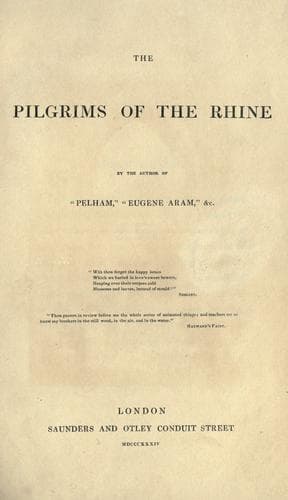
The Pilgrims of the RhineLytton, Edward Bulwer Lytton, Baron
Science
The Pilgrims of the Rhine
Lytton, Edward Bulwer Lytton, Baron
Fairies -- Fiction; Fantasy fiction; Rhine River Valley -- Fiction
“In most cases I was threatened with the stocks, and twice I was
consigned by the _juge de paix_ to the village police, to be passed
to some mystic Mecca they were pleased to entitle ‘a parish.’ Ah”
(continued the German with much _bonhomie_), “it was a pity to see in a
great nation so much value attached to such a trifle as money. But what
surprised me greatly was the tone of your poetry. Madame de Stael, who
knew perhaps as much of England as she did of Germany, tells us that its
chief character is the _chivalresque_; and, excepting only Scott, who,
by the way, is _not_ English, I did not find one chivalrous poet among
you. Yet,” continued the student, “between ourselves, I fancy that in
our present age of civilization, there is an unexamined mistake in the
general mind as to the value of poetry. It delights still as ever, but
it has ceased to teach. The prose of the heart enlightens, touches,
rouses, far more than poetry. Your most philosophical poets would be
commonplace if turned into prose. Verse cannot contain the refining
subtle thoughts which a great prose writer embodies; the rhyme eternally
cripples it; it properly deals with the common problems of human nature,
which are now hackneyed, and not with the nice and philosophizing
corollaries which may be drawn from them. Thus, though it would seem
at first a paradox, commonplace is more the element of poetry than of
prose.”
This sentiment charmed Vane, who had nothing of the poet about him;
and he took the student to share their breakfast at the inn, with
a complacency he rarely experienced at the remeeting with a new
acquaintance.
After breakfast, our party proceeded through the town towards the
wonderful castle which is its chief attraction, and the noblest wreck of
German grandeur.
And now pausing, the mountain yet unscaled, the stately ruin frowned
upon them, girt by its massive walls and hanging terraces, round which
from place to place clung the dwarfed and various foliage. High at the
rear rose the huge mountain, covered, save at its extreme summit, with
dark trees, and concealing in its mysterious breast the shadowy beings
of the legendary world. But towards the ruins, and up a steep ascent,
you may see a few scattered sheep thinly studding the broken ground.
Aloft, above the ramparts, rose, desolate and huge, the Palace of the
Electors of the Palatinate. In its broken walls you may trace the tokens
of the lightning that blasted its ancient pomp, but still leaves in the
vast extent of pile a fitting monument of the memory of Charlemagne.
Below, in the distance, spread the plain far and spacious, till the
shadowy river, with one solitary sail upon its breast, united the
melancholy scene of earth with the autumnal sky.
Public-domain text, read in full here on John Shaqi.
Reviews
Reviews
No reviews yet
Be the first to share your thoughts on this work.
Elsewhere in the archive
Join the Discussion
Join the discussion
Sign in to leave a comment or review.
Sign InorCreate an account