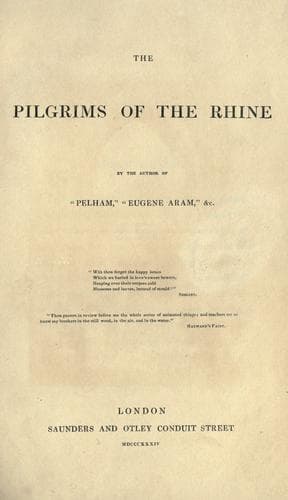
The Pilgrims of the RhineLytton, Edward Bulwer Lytton, Baron
Science
The Pilgrims of the Rhine
Lytton, Edward Bulwer Lytton, Baron
Fairies -- Fiction; Fantasy fiction; Rhine River Valley -- Fiction
and watching there through the long night, and felt that the children
of earth have still something that unites them to the spirits of a finer
race, so long as they retain amongst them the presence of real love!”
And oh! is there not a truth also in our fictions of the Unseen World?
Are there not yet bright lingerers by the forest and the stream? Do the
moon and the soft stars look out on no delicate and winged forms bathing
in their light? Are the fairies and the invisible hosts but the children
of our dreams, and not their inspiration? Is that all a delusion which
speaks from the golden page? And is the world only given to harsh and
anxious travellers that walk to and fro in pursuit of no gentle shadows?
Are the chimeras of the passions the sole spirits of the universe? No!
while my remembrance treasures in its deepest cell the image of one no
more,--one who was “not of the earth, earthy;” one in whom love was the
essence of thoughts divine; one whose shape and mould, whose heart and
genius, would, had Poesy never before dreamed it, have called forth
the first notion of spirits resembling mortals, but not of them,--no,
Gertrude! while I remember you, the faith, the trust in brighter shapes
and fairer natures than the world knows of, comes clinging to my heart;
and still will I think that Fairies might have watched over your sleep
and Spirits have ministered to your dreams.
CHAPTER III. FEELINGS.
GERTRUDE and her companions proceeded by slow and, to her, delightful
stages to Rotterdam. Trevylyan sat by her side, and her hand was ever
in his; and when her delicate frame became sensible of fatigue, her head
drooped on his shoulder as its natural resting-place. Her father was
a man who had lived long enough to have encountered many reverses of
fortune, and they had left him, as I am apt to believe long adversity
usually does leave its prey, somewhat chilled and somewhat hardened to
affection; passive and quiet of hope, resigned to the worst as to
the common order of events, and expecting little from the best, as an
unlooked-for incident in the regularity of human afflictions. He was
insensible of his daughter’s danger, for he was not one whom the fear
of love endows with prophetic vision; and he lived tranquilly in the
present, without asking what new misfortune awaited him in the future.
Yet he loved his child, his only child, with whatever of affection
was left him by the many shocks his heart had received; and in her
approaching connection with one rich and noble as Trevylyan, he
felt even something bordering upon pleasure. Lapped in the apathetic
indifference of his nature, he leaned back in the carriage, enjoying the
bright weather that attended their journey, and sensible--for he was one
of fine and cultivated taste--of whatever beauties of nature or remains
of art varied their course. A companion of this sort was the most
agreeable that two persons never needing a third could desire; he left
Public-domain text, read in full here on John Shaqi.
Reviews
Reviews
No reviews yet
Be the first to share your thoughts on this work.
Join the Discussion
Join the discussion
Sign in to leave a comment or review.
Sign InorCreate an account