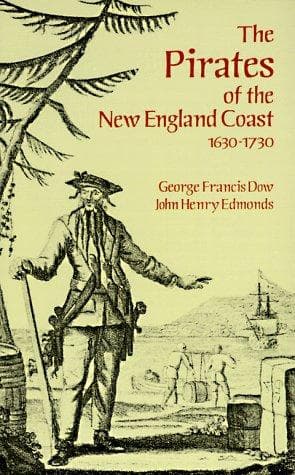
The pirates of the New England coast, 1630-1730 — John Shaqi
The pirates of the New England coast, 1630-1730Dow, George Francis
History
The pirates of the New England coast, 1630-1730
Dow, George Francis
New England -- History -- Colonial period, ca. 1600-1775; Pirates -- New England -- History
Not infrequently it was difficult to separate privateering from piracy.
John Quelch, who was hanged in Boston for piracy, in 1704, preyed upon
Portuguese commerce as he supposed in safety and not until he returned
to Marblehead did he learn of the treaty of peace that made him a
pirate. In 1653, Thomas Harding captured a rich prize sailing from
Barbadoes and in consequence was tried in Boston for piracy, but saved
his neck when he was able to prove that the vessel was Dutch and not
Spanish. In 1692, the Governor and Council of Connecticut were informed
that “a catch and 2 small sloops, with about 30 or 40 privateers or
rather pirates,” were anchored off East Hampton, Long Island, and had
sold a ketch to Mr. Hutchinson of Boston and bought a sloop of Captain
Hubbard, also of Boston.
Newport, R. I., sent out many privateers. In 1702 it was reported that
nearly all of the able-bodied men on the Island were away privateering.
The town also profited frequently from the visits of known pirates,
as in 1688, when Peterson, in a “barkalonga” of ten guns and seventy
men, refitted at Newport and no bill could be obtained against him from
the grand jury as they were neighbors and friends of many of the men
on board. Two Salem ketches also traded with him and a master of one
brought into “Martin’s Vineyard,” a prize that Peterson “the pirate,
had taken in the West Indies.”[12] Andrew Belcher, a well-known Boston
merchant and master of the ship “Swan,” paid Peterson £57, in money and
provisions, for hides and elephants’ teeth taken from his plunder.
The ill-defined connection between privateering and piracy was fully
recognized in those days and characterized publicly by the clergy. In
1704 when Rev. Cotton Mather preached his “Brief Discourse occasioned
by a Tragical Spectacle in a Number of Miserables under Sentence of
Death for Piracy,” he remarked that “the Privateering Stroke so easily
degenerates into the Piratical; and the Privateering Trade is usually
carried on with an Unchristian Temper, and proves an Inlet unto so much
Debauchery and Iniquity.”
The Treaty of Aix-la-Chapelle, by which peace was made between England
and Spain, was signed in 1668, but the colonial authorities were
so little concerned by the depredations of the English privateers
on Spanish commerce in the West Indies that their commissions were
not revoked until 1672 and even then, for a time, the doings of the
adventurous, privately armed vessels were not scrutinized too closely.
Public-domain text, read in full here on John Shaqi.
Reviews
Reviews
No reviews yet
Be the first to share your thoughts on this work.
Join the Discussion
Join the discussion
Sign in to leave a comment or review.
Sign InorCreate an account