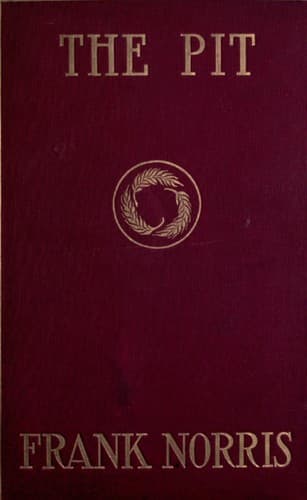
Chicago (Ill.) -- Fiction; Didactic fiction; Domestic fiction; Married people -- Fiction; Psychological fiction; Wheat trade -- Fiction
But it was only this realisation of certain responsibilities that
during the first years of her married life at any time drew away
Laura's consideration of her husband. She began to get acquainted with
the real man-within-the-man that she knew now revealed himself only
after marriage. Jadwin her husband was so different from, so infinitely
better than, Jadwin her lover, that Laura sometimes found herself
looking back with a kind of retrospective apprehension on the old days
and the time when she was simply Miss Dearborn. How little she had
known him after all! And how, in the face of this ignorance, this
innocence, this absence of any insight into his real character, had she
dared to take the irretrievable step that bound her to him for life?
The Curtis Jadwin of those early days was so much another man. He might
have been a rascal; she could not have known it. As it was, her husband
had promptly come to be, for her, the best, the finest man she had ever
known. But it might easily have been different.
His attitude towards her was thoughtfulness itself. Hardly ever was he
absent from her, even for a day, that he did not bring her some little
present, some little keep-sake--or even a bunch of flowers--when he
returned in the evening. The anniversaries--Christmas, their wedding
day, her birthday--he always observed with great eclat. He took a
holiday from his business, surprised her with presents under her
pillow, or her dinner-plate, and never failed to take her to the
theatre in the evening.
However, it was not only Jadwin's virtues that endeared him to his
wife. He was no impeccable hero in her eyes. He was tremendously human.
He had his faults, his certain lovable weaknesses, and it was precisely
these traits that Laura found so adorable.
For one thing, Jadwin could be magnificently inconsistent. Let him set
his mind and heart upon a given pursuit, pleasure, or line of conduct
not altogether advisable at the moment, and the ingenuity of the
excuses by which he justified himself were monuments of elaborate
sophistry. Yet, if later he lost interest, he reversed his arguments
with supreme disregard for his former words.
Then, too, he developed a boyish pleasure in certain unessential though
cherished objects and occupations, that he indulged extravagantly and
to the neglect of things, not to say duties, incontestably of more
importance.
Public-domain text, read in full here on John Shaqi.
Reviews
Reviews
No reviews yet
Be the first to share your thoughts on this work.
Elsewhere in the archive
Join the Discussion
Join the discussion
Sign in to leave a comment or review.
Sign InorCreate an account