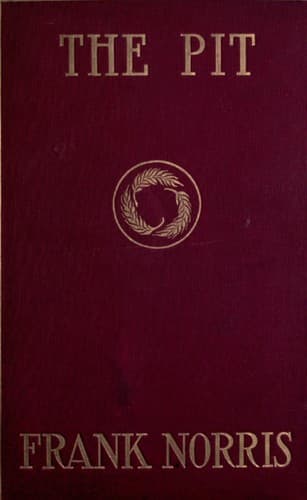
Chicago (Ill.) -- Fiction; Didactic fiction; Domestic fiction; Married people -- Fiction; Psychological fiction; Wheat trade -- Fiction
The opera continued. The great soprano, the prima donna, appeared and
delivered herself of a song for which she was famous with astonishing
eclat. Then in a little while the stage grew dark, the orchestration
lapsed to a murmur, and the tenor and the soprano reentered. He clasped
her in his arms and sang a half-dozen bars, then holding her hand, one
arm still about her waist, withdrew from her gradually, till she
occupied the front-centre of the stage. He assumed an attitude of
adoration and wonderment, his eyes uplifted as if entranced, and she,
very softly, to the accompaniment of the sustained, dreamy chords of
the orchestra, began her solo.
Laura shut her eyes. Never had she felt so soothed, so cradled and
lulled and languid. Ah, to love like that! To love and be loved. There
was no such love as that to-day. She wished that she could loose her
clasp upon the sordid, material modern life that, perforce, she must
hold to, she knew not why, and drift, drift off into the past, far
away, through rose-coloured mists and diaphanous veils, or resign
herself, reclining in a silver skiff drawn by swans, to the gentle
current of some smooth-flowing river that ran on forever and forever.
But a discordant element developed. Close by--the lights were so low
she could not tell where--a conversation, kept up in low whispers,
began by degrees to intrude itself upon her attention. Try as she
would, she could not shut it out, and now, as the music died away
fainter and fainter, till voice and orchestra blended together in a
single, barely audible murmur, vibrating with emotion, with romance,
and with sentiment, she heard, in a hoarse, masculine whisper, the
words:
"The shortage is a million bushels at the very least. Two hundred
carloads were to arrive from Milwaukee last night."
She made a little gesture of despair, turning her head for an instant,
searching the gloom about her. But she could see no one not interested
in the stage. Why could not men leave their business outside, why must
the jar of commerce spoil all the harmony of this moment.
However, all sounds were drowned suddenly in a long burst of applause.
The tenor and soprano bowed and smiled across the footlights. The
soprano vanished, only to reappear on the balcony of the pavilion, and
while she declared that the stars and the night-bird together sang "He
loves thee," the voices close at hand continued:
"--one hundred and six carloads--"
"--paralysed the bulls--"
"--fifty thousand dollars--"
Then all at once the lights went up. The act was over.
Public-domain text, read in full here on John Shaqi.
Reviews
Reviews
No reviews yet
Be the first to share your thoughts on this work.
Join the Discussion
Join the discussion
Sign in to leave a comment or review.
Sign InorCreate an account