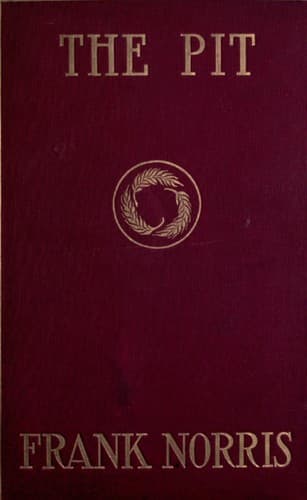
Chicago (Ill.) -- Fiction; Didactic fiction; Domestic fiction; Married people -- Fiction; Psychological fiction; Wheat trade -- Fiction
The violins raged and wailed in unison, all the bows moving together
like parts of a well-regulated machine. The kettle-drums, marking the
cadences, rolled at exact intervals. The director beat time furiously,
as though dragging up the notes and chords with the end of his baton,
while the horns and cornets blared, the bass viols growled, and the
flageolets and piccolos lost themselves in an amazing complication of
liquid gurgles and modulated roulades.
On the stage every one was singing. The soprano in the centre,
vocalised in her highest register, bringing out the notes with vigorous
twists of her entire body, and tossing them off into the air with sharp
flirts of her head. On the right, the basso, scowling, could be heard
in the intervals of the music repeating
"Il perfido, l'ingrato"
while to the left of the soprano, the baritone intoned
indistinguishable, sonorous phrases, striking his breast and pointing
to the fallen tenor with his sword. At the extreme left of the stage
the contralto, in tights and plush doublet, turned to the audience,
extending her hands, or flinging back her arms. She raised her eyebrows
with each high note, and sunk her chin into her ruff when her voice
descended. At certain intervals her notes blended with those of the
soprano's while she sang:
"Addio, felicita del ciel!"
The tenor, raised upon one hand, his shoulders supported by his
friends, sustained the theme which the soprano led with the words:
"Je me meurs
Ah malheur
Ah je souffre
Mon ame s'envole."
The chorus formed a semi-circle just behind him. The women on one side,
the men on the other. They left much to be desired; apparently scraped
hastily together from heaven knew what sources, after the manner of a
management suddenly become economical. The women were fat, elderly, and
painfully homely; the men lean, osseous, and distressed, in misfitting
hose. But they had been conscientiously drilled. They made all their
gestures together, moved in masses simultaneously, and, without
ceasing, chanted over and over again:
"O terror, O blasfema."
The finale commenced. Everybody on the stage took a step forward,
beginning all over again upon a higher key. The soprano's voice
thrilled to the very chandelier. The orchestra redoubled its efforts,
the director beating time with hands, head, and body.
"Il perfido, l'ingrato"
thundered the basso.
"Ineffabil mistero,"
answered the baritone, striking his breast and pointing with his sword;
while all at once the soprano's voice, thrilling out again, ran up an
astonishing crescendo that evoked veritable gasps from all parts of the
audience, then jumped once more to her famous C in alt, and held it
long enough for the chorus to repeat
"O terror, O blasfema"
four times.
Public-domain text, read in full here on John Shaqi.
Reviews
Reviews
No reviews yet
Be the first to share your thoughts on this work.
Join the Discussion
Join the discussion
Sign in to leave a comment or review.
Sign InorCreate an account