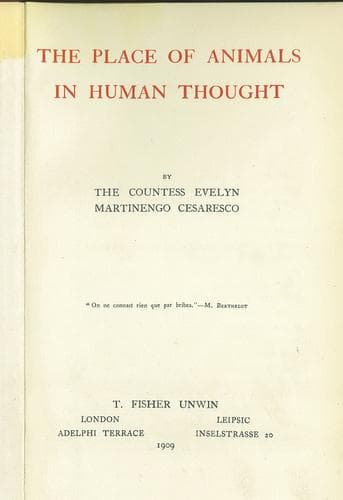
The Place of Animals in Human Thought
I
SOUL-WANDERING AS IT CONCERNS ANIMALS
IN one of these enigmatic sayings which launch the mind on boundless
seas, Cardinal Newman remarked that we know less of animals than of
angels. A large part of the human race explains the mystery by what is
called transmigration, metempsychosis, _Samsara_, _Seelenwanderung_; the
last a word so compact and picturesque that it is a pity not to imitate
it in English. The intelligibility of ideas depends much on whether
words touch the spring of the picture-making wheel of the brain;
“Soul-wandering” does this.
Ancient as the theory is, we ought to remember what is commonly
forgotten—that somewhere in the distance we catch sight of a time when
it was unknown, at least in the sense of a procession of the soul from
death to life through animal forms. Traces of it are to be found in the
Sutras and it is thoroughly developed in the Upanishads, but if the
Sutras belong to the thirteenth century and the Upanishads to about the
year 700 before Christ, a long road still remains to the Vedas with
their fabulous antiquity.
In the Vedas it is stated that the soul may wander, even during sleep,
and that it will surely have a further existence after death, but there
is nothing to show that in this further existence it will take the form
of an animal. Man will be substantially man, able to feel the same
pleasures as his prototype on earth; but if he goes to a good place,
exempt from the same pains. What, then, was the Vedic opinion of
animals? On the whole, it is safe to assume that the authors of the
Vedic chants believed that animals, like men, entered a soul-world in
which they preserved their identity. The idea of funeral sacrifices, as
exemplified in these earliest records, was that of sending some one
before. The horse and the goat that were immolated at a Vedic funeral
were intended to go and announce the coming of the man’s soul. Wherever
victims were sacrificed at funerals, they were originally meant to do
something in the after-life; hence they must have had souls. The origin
of the Suttee was the wish that the wife should accompany her husband,
and among primitive peoples animals were sacrificed because the dead man
might have need of them. Not very long ago an old Irish woman, on being
remonstrated with for having killed her dead husband’s horse, replied
with the words, “Do you think I would let my man go on foot in the next
world?” On visiting that wonderfully emotion-awakening relic, the Viking
ship at Christiania, I was interested to see the bones of the Chief’s
horses and dogs as well as his own. Did the Norsemen, passionately
devoted to the sea as they were, suppose, that not only the animals, but
also the vessel in which they buried their leader, would have a ghostly
second existence? I have no doubt that they did. Apart from what hints
Public-domain text, read in full here on John Shaqi.
Reviews
Reviews
No reviews yet
Be the first to share your thoughts on this work.
Join the Discussion
Join the discussion
Sign in to leave a comment or review.
Sign InorCreate an account