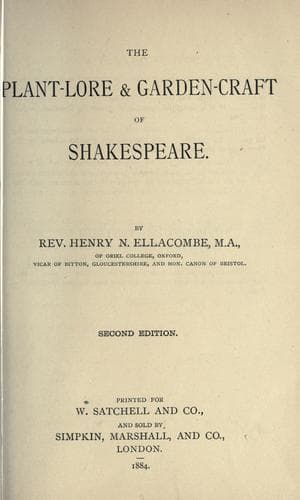
The plant-lore & garden-craft of ShakespeareEllacombe, Henry Nicholson
General
The plant-lore & garden-craft of Shakespeare
Ellacombe, Henry Nicholson
Gardens in literature; Plants in literature; Shakespeare, William, 1564-1616 -- Knowledge -- Botany
_Winter's Tale_, act iv, sc. 4 (103).
(2) _Armado._
I am that flower,
_Dumain._
That Mint.
_Longaville._
That Columbine.
_Love's Labour's Lost_, act v, sc. 2 (661).
The Mints are a large family of highly-perfumed, strong-flavoured
plants, of which there are many British species, but too well known to
call for any further description.
MISTLETOE.
_Tamora._
The trees, though summer, yet forlorn and lean,
O'ercome with Moss and baleful Mistletoe.
_Titus Andronicus_, act ii, sc. 3 (94).
The Mistletoe was a sore puzzle to our ancestors, almost as great a
mystery as the Fern. While they admired its fresh, evergreen branches,
and pretty transparent fruit, and used it largely in the decoration of
their houses at Christmas, they looked on the plant with a certain awe.
Something of this, no doubt, arose from its traditional connection with
the Druids, which invested the plant with a semi-sacred character, as a
plant that could drive away evil spirits; yet it was also looked upon
with some suspicion, perhaps also arising from its use by our heathen
ancestors, so that, though admitted into houses, it was not (or very
seldom) admitted into churches. And this character so far still attaches
to the Mistletoe, that it is never allowed with the Holly and Ivy and
Box to decorate the churches, and Gay's lines were certainly written in
error--
"Now with bright Holly all the temples strow,
With Laurel green and sacred Mistletoe."
The mystery attaching to the Mistletoe arose from the ignorance as to
its production. It was supposed not to grow from its seeds, and how it
was produced was a fit subject for speculation and fable. Virgil tells
the story thus--
"Quale solet sylvis brumali frigore viscum
Fronde virere novâ, quod non sua seminat arbos,
Et croceo fœtu teretes circumdare truncos."
_Æneid_, vi, 205.
In this way Virgil elegantly veils his ignorance, but his commentator in
the eighteenth century (Delphic Classics) tells the tale without any
doubts as to its truth. "Non nascitur e semine proprio arboris, at neque
ex insidentum volucrum fimo, ut putavere veteres, sed ex ipso arborum
vitali excremento." This was the opinion of the great Lord Bacon; he
ridiculed the idea that the Mistletoe was propagated by the operation of
a bird as an idle tradition, saying that the sap which produces the
plant is such as "the tree doth excerne and cannot assimilate," and
Browne ("Vulgar Errors") was of the same opinion. But the opposite
opinion was perpetuated in the very name ("Mistel: fimus, muck,"
Cockayne),[163:1] and was held without any doubt by most of the writers
in Shakespeare's time--
Public-domain text, read in full here on John Shaqi.
Reviews
Reviews
No reviews yet
Be the first to share your thoughts on this work.
Elsewhere in the archive
Join the Discussion
Join the discussion
Sign in to leave a comment or review.
Sign InorCreate an account