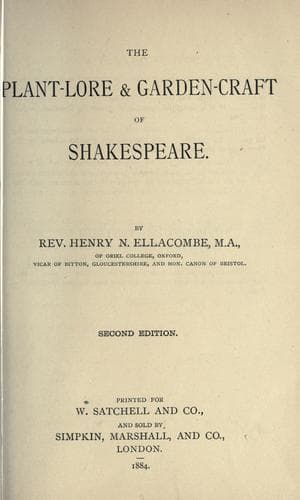
The plant-lore & garden-craft of ShakespeareEllacombe, Henry Nicholson
General
The plant-lore & garden-craft of Shakespeare
Ellacombe, Henry Nicholson
Gardens in literature; Plants in literature; Shakespeare, William, 1564-1616 -- Knowledge -- Botany
"Upon the oak, the plumb-tree and the holme,
The stock-dove and the blackbird should not come,
Whose mooting on the trees does make to grow
Rots-curing hyphear, and the Mistletoe."
BROWNE, _Brit. Past._ i, 1.
So that we need not blame Gerard when he boldly said that "this
excrescence hath not any roote, neither doth encrease himselfe of his
seed, as some have supposed, but it rather commethe of a certaine
moisture gathered together upon the boughes and joints of the trees,
through the barke whereof this vaporous moisture proceeding bringeth
forth the Misseltoe." We now know that it is produced exclusively from
the seeds probably lodged by the birds, and that it is easily grown and
cultivated. It will grow and has been found on almost any deciduous
tree, preferring those with soft bark, and growing very seldom on the
Oak.[163:2] Those who wish for full information upon the proportionate
distribution of the Mistletoe on different British trees will find a
good summary in "Notes and Queries," vol. iii. p. 226.
FOOTNOTES:
[163:1] "_Mistel_ est a _mist_ stercus, quod ex stercore avium
pronascitur, nec aliter pronasci potest."--WACHTER, _Glossary_ (quoted
in "Notes and Queries," 3rd series, vii. 157. In the same volume are
several papers on the origin of the word). Dr. Prior derives it from
_mistl_ (different), and _tan_ (twig), being so unlike the tree it grows
upon.
[163:2] Mistletoe growing on an oak had a special legendary value. Its
rarity probably gave it value in the eyes of the Druids, and much later
it had its mystic lore. "By sitting upon a hill late in a evening, near
a Wood, in a few nights a fire drake will appeare, mark where it
lighteth, and then you shall find an oake with Mistletoe thereon, at the
Root whereof there is a Misle-childe, whereof many strange things are
conceived. _Beati qui non crediderunt._"--PLAT., _Garden of Eden_, 1659,
No. 68.
MOSS.
(1) _Adriana._
If ought possess thee from me, it is dross,
Usurping Ivy, Brier, or idle Moss.
_Comedy of Errors_, act ii, sc. 2 (179).
(2) _Tamora._
The trees, though summer, yet forlorn and lean,
O'ercome with Moss and baleful Mistletoe.
_Titus Andronicus_, act ii, sc. 3 (94).
(3) _Apemantus._
These Moss'd trees
That have outlived the eagle.
_Timon of Athens_, act iv, sc. 3 (223).
(4) _Hotspur._
Steeples and Moss-grown towers.
_1st Henry IV_, act iii, sc. 1 (33).
(5) _Oliver._
Under an Oak whose boughs were Moss'd with age,
And high top bald with dry antiquity.
_As You Like It_, act iv, sc. 3 (105).
(6) _Arviragus._
The ruddock would,
With charitable bill,
* * * * *
Public-domain text, read in full here on John Shaqi.
Reviews
Reviews
No reviews yet
Be the first to share your thoughts on this work.
Elsewhere in the archive
Join the Discussion
Join the discussion
Sign in to leave a comment or review.
Sign InorCreate an account