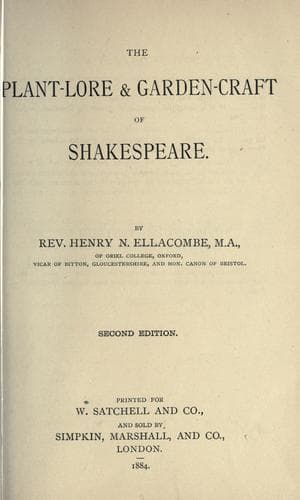
The plant-lore & garden-craft of ShakespeareEllacombe, Henry Nicholson
General
The plant-lore & garden-craft of Shakespeare
Ellacombe, Henry Nicholson
Gardens in literature; Plants in literature; Shakespeare, William, 1564-1616 -- Knowledge -- Botany
We do not know when the Mulberry, which is an Eastern tree, was
introduced into England, but probably very early. We find in Archbishop
Ælfric's "Vocabulary," "morus vel rubus, mor-beam," but it is doubtful
whether that applies to the Mulberry or Blackberry, as in the same
catalogue Blackberries are mentioned as "flavi vel mori, blace-berian."
There is no doubt that Morum was a Blackberry as well as a Mulberry in
classical times. Our Mulberry is probably the fruit mentioned by
Horace--
"Ille salubres
Æstates peraget, qui nigris prandia Moris
Finiet ante gravem quæ legerit arbore solem."
_Sat._ ii, 4, 24.
And it certainly is the fruit mentioned by Ovid--
"In duris hærentia mora rubetis."
_Metam._, i, 105.
In the Dictionarius of John de Garlande (thirteenth century)[167:1] we
find, "Hec sunt nomina silvestrium arborum, qui sunt in luco magistri
Johannis; quercus cum fago, pinus cum lauro, celsus gerens celsa;" and
Mr. Wright translates "celsa" by "Mulberries," without, however, giving
his authority for this translation.[167:2] But whenever introduced, it
had been long established in England in Shakespeare's time.
It must have been a common tree even in Anglo-Saxon times, for the
favourite drink, Morat, was a compound of honey flavoured with
Mulberries (Turner's "Anglo-Saxons").[167:3] Spenser spoke of it--
"With love juice stained the Mulberie,
The fruit that dewes the poet's braine."
_Elegy_, 18.
Gerard describes it as "high and full of boughes," and growing in sundry
gardens in England, and he grew in his own London garden both the Black
and the White Mulberry. Lyte also, before Gerard, describes it and says:
"It is called in the fayning of Poetes the wisest of all other trees,
for this tree only among all others bringeth forth his leaves after the
cold frostes be past;" and the Mulberry Garden, often mentioned by the
old dramatists, "occupied the site of the present Buckingham Palace and
Gardens, and derived its name from a garden of Mulberry trees planted by
King James I. in 1609, in which year 935_l._ was expended by the king in
the planting of Mulberry trees near the Palace of Westminster."[168:1]
As an ornamental tree for any garden, the Mulberry needs no
recommendation, being equally handsome in shape, in foliage, and in
fruit. It is a much prized ornament in all old gardens, so that it has
been well said that an old Mulberry tree on the lawn is a patent of
nobility to any garden; and it is most easy of cultivation; it will bear
removal when of a considerable size, and so easily can it be propagated
from cuttings that a story is told of Mr. Payne Knight that he cut large
branches from a Mulberry tree to make standards for his clothes-lines,
and that each standard took root, and became a flourishing Mulberry
tree.
Public-domain text, read in full here on John Shaqi.
Reviews
Reviews
No reviews yet
Be the first to share your thoughts on this work.
Elsewhere in the archive
Join the Discussion
Join the discussion
Sign in to leave a comment or review.
Sign InorCreate an account