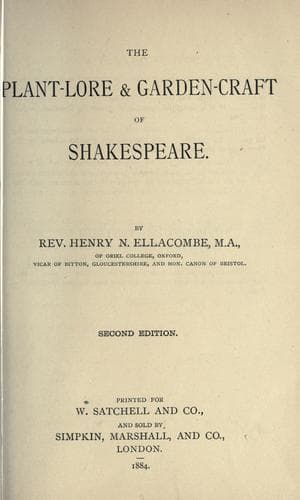
The plant-lore & garden-craft of ShakespeareEllacombe, Henry Nicholson
General
The plant-lore & garden-craft of Shakespeare
Ellacombe, Henry Nicholson
Gardens in literature; Plants in literature; Shakespeare, William, 1564-1616 -- Knowledge -- Botany
Though most of us only know of the common White or Black Mulberry, yet,
where it is grown for silk culture (as it is now proposed to grow it in
England, with a promised profit of from £70 to £100 per acre for the
silk, and an additional profit of from £100 to £500 per acre from the
grain (eggs)!!), great attention is paid to the different varieties; so
that M. de Quatrefuges briefly describes six kinds cultivated in one
valley in France, and Royle remarks, "so many varieties have been
produced by cultivation that it is difficult to ascertain whether they
all belong to one species; they are," as he adds, "nearly as numerous as
those of the silkworm" (Darwin).
We have good proof of Shakespeare's admiration of the Mulberry in the
celebrated Shakespeare Mulberry growing in his garden at New Place at
Stratford-on-Avon. "That Shakespeare planted this tree is as well
authenticated as anything of that nature can be, . . . and till this was
planted there was no Mulberry tree in the neighbourhood. The tree was
celebrated in many a poem, one especially by Dibdin, but about 1752,
the then owner of New Place, the Rev. Mr. Gastrell, bought and pulled
down the house, and wishing, as it should seem, to be 'damned to
everlasting fame,' he had some time before cut down Shakespeare's
celebrated Mulberry tree, to save himself the trouble of showing it to
those whose admiration of our great poet led them to visit the poetick
ground on which it stood."--MALONE. The pieces were made into many
snuff-boxes[169:1] and other mementoes of the tree.
"The Mulberry tree was hung with blooming wreaths;
The Mulberry tree stood centre of the dance;
The Mulberry tree was hymn'd with dulcet strains;
And from his touchwood trunk the Mulberry tree
Supplied such relics as devotion holds
Still sacred, and preserves with pious care."
COWPER, _Task_, book vi.
FOOTNOTES:
[167:1] The Dictionarius of John de Garlande is published in Wright's
"Vocabularies." His garden was probably in the neighbourhood of Paris,
but he was a thorough Englishman, and there is little doubt that his
description of a garden was drawn as much from his English as from his
French experience.
[167:2] The authority may be in the "Promptorium Parvulorum:" "Mulberry,
Morum (selsus)."
[167:3] "Moratum potionis genus, f. ex vino et moris dilutis
confectæ."--_Glossarium Adelung._
[168:1] Cunningham's "Handbook of London," p. 346, with many quotations
from the old dramatists.
[169:1] Some of these snuff-boxes were inscribed with the punning motto
"Memento Mori."
MUSHROOMS.
(1) _Prospero._
You demi-puppets, that
By moonshine do the greensour ringlets make,
Whereof the ewe not bites, and you whose pastime
Is to make midnight Mushrooms.
_Tempest_, act v, sc. 1 (36).
(2) _Fairy._
Public-domain text, read in full here on John Shaqi.
Reviews
Reviews
No reviews yet
Be the first to share your thoughts on this work.
Elsewhere in the archive
Join the Discussion
Join the discussion
Sign in to leave a comment or review.
Sign InorCreate an account