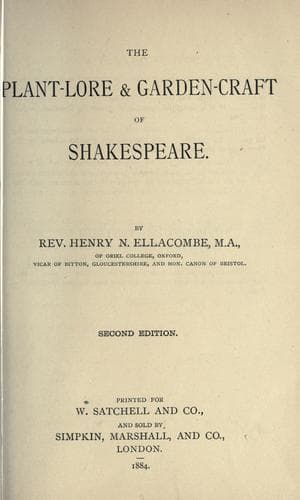
The plant-lore & garden-craft of ShakespeareEllacombe, Henry Nicholson
General
The plant-lore & garden-craft of Shakespeare
Ellacombe, Henry Nicholson
Gardens in literature; Plants in literature; Shakespeare, William, 1564-1616 -- Knowledge -- Botany
have, indeed, grieved when I reflected on the straitened conditions of
the lower orders to see pounds innumerable of extempore beefsteaks
growing on our Oaks in the shape of _Fistula hepatica_; _Ag. fusipes_,
to pickle in clusters under them; _Puffballs_, which some of our friends
have not inaptly compared to sweet-bread for the rich delicacy of their
unassisted flavour; _Hydna_, as good as oysters, which they very much
resemble in taste; _Agaricus deliciosus_, reminding us of tender lamb's
kidneys: the beautiful yellow _Chantarelle_, that _kalon kagathon_ of
diet, growing by the bushel, and no basket but our own to pick up a few
specimens in our way; the sweet nutty-flavoured _Boletus_, in vain
calling himself _edulis_ when there was none to believe him; the dainty
_Orcella_; the _Ag. hetherophyllus_, which tastes like the crawfish when
grilled; the _Ag. ruber_ and _Ag. virescens_, to cook in any way, and
equally good in all."
As to the fairy rings (Nos. 1, 2, and 3) a great amount of legendary
lore was connected with them. Browne notices them--
"A pleasant mead
Where fairies often did their measures tread,
Which in the meadows makes such circles green
As if with garlands it had crowned been."
_Britannia's Pastorals._
Cowley said--
"Where once such fairies dance,
No grass does ever grow;"
and in Shakespeare's time the sheep refused to eat the grass on the
fairy rings (1); I believe they now feed on it, but I have not been able
to ascertain this with certainty. Others, besides the sheep, avoided
them. "When the damsels of old gathered may-dew on the grass, which they
made use of to improve their complexions, they left undisturbed such of
it as they perceived on the fairy rings, apprehensive that the fairies
should in revenge destroy their beauty, nor was it reckoned safe to put
the foot within the rings, lest they should be liable to fairies'
power."--DOUCE'S _Illustrations_, p. 180.
FOOTNOTES:
[170:1] Herrick calls them "brownest Toadstones."
MUSK ROSES, _see_ ROSE.
MUSTARD.
(1) _Doll._
They say Poins has a good wit.
_Falstaff._
He a good wit? hang him, baboon! his wit's as thick as
Tewksbury Mustard; there is no more conceit in him than in a
mallet.
_2nd Henry IV_, act ii, sc. 4 (260).
(2) _Titania._
Pease-blossom! Cobweb! Moth! and Mustardseed!
* * * * *
_Bottom._
Your name, I beseech you, sir?
_Mustardseed._
Mustardseed.
_Bottom._
Good Master Mustardseed, I know your patience well; that same
cowardly giant-like ox-beef hath devoured many a gentleman
of your house: I promise you your kindred hath made my eyes
water ere now. I desire your more acquaintance, good Master
Mustardseed.
Public-domain text, read in full here on John Shaqi.
Reviews
Reviews
No reviews yet
Be the first to share your thoughts on this work.
Elsewhere in the archive
Join the Discussion
Join the discussion
Sign in to leave a comment or review.
Sign InorCreate an account