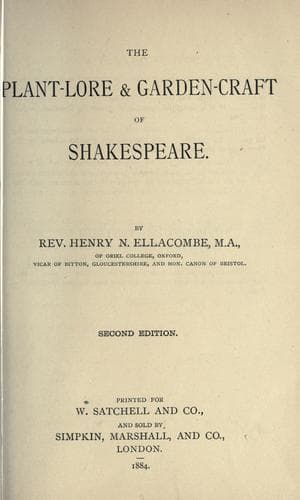
The plant-lore & garden-craft of ShakespeareEllacombe, Henry Nicholson
General
The plant-lore & garden-craft of Shakespeare
Ellacombe, Henry Nicholson
Gardens in literature; Plants in literature; Shakespeare, William, 1564-1616 -- Knowledge -- Botany
I do wander everywhere.
Swifter than the moon's sphere;
And I serve the fairy queen,
To dew her orbs upon the green.
_Midsummer Night's Dream_, act ii, sc. 1 (6).
(3) _Quickly._
And nightly, meadow-fairies, look you sing,
Like to the Garter's compass, in a ring:
The expressure that it bears, green let it be,
More fertile-fresh than all the field to see.
_Merry Wives_, act v, sc. 5 (69).
(4) _Ajax._
Toadstool, learn me the proclamation.
_Troilus and Cressida_, act ii, sc. 1 (22).
The three first passages, besides the notice of the Mushroom, contain
also the notice of the fairy-rings, which are formed by fungi, though
probably Shakespeare knew little of this. No. 4 names the Toadstool, and
the four passages together contain the whole of Shakespeare's fungology,
and it is little to be wondered at that he has not more to say on these
curious plants. In his time "Mushrumes or Toadstooles" (they were all
classed together) were looked on with very suspicious eyes, though they
were so much eaten that we frequently find in the old herbals certain
remedies against "a surfeit of Mushrooms." Why they should have been
connected with toads has never been explained, but it was always so--
"The grieslie Todestoole growne there mought I see,
And loathed paddocks lording on the same."--SPENSER.
They were associated with other loathsome objects besides toads, for
"Poisonous Mushrooms groweth where old rusty iron lieth, or rotten
clouts, or neere to serpent's dens or rootes of trees that bring forth
venomous fruit.[170:1]. . . Few of them are good to be eaten, and most
of them do suffocate and strangle the eater. Therefore, I give my advice
unto those that love such strange and new-fangled meates to beware of
licking honey among thornes, lest the sweetnesse of one do not
counteracte the sharpnesse and pricking of the other." This was Gerard's
prudent advice on the eating of "Mushrumes and Toadstooles," but
nowadays we know better. The fungologists tell us that those who refuse
to eat any fungus but the Mushroom (_Agaricus campestris_) are not only
foolish in rejecting most delicate luxuries, but also very wrong in
wasting most excellent and nutritious food. Fungologists are great
enthusiasts, and it may be well to take their prescription _cum grano
salis_; but we may qualify Gerard's advice by the well-known
enthusiastic description of Dr. Badham, who certainly knew much more of
fungology than Gerard, and did not recommend to others what he had not
personally tried himself. After praising the beauty of an English
autumn, even in comparison with Italy, he thus concludes his pleasant
and useful book, "The Esculent Funguses of England": "I have myself
witnessed whole hundredweights of rich, wholesome diet rotting under
trees, woods teeming with food, and not one hand to gather it. . . . I
Public-domain text, read in full here on John Shaqi.
Reviews
Reviews
No reviews yet
Be the first to share your thoughts on this work.
Elsewhere in the archive
Join the Discussion
Join the discussion
Sign in to leave a comment or review.
Sign InorCreate an account