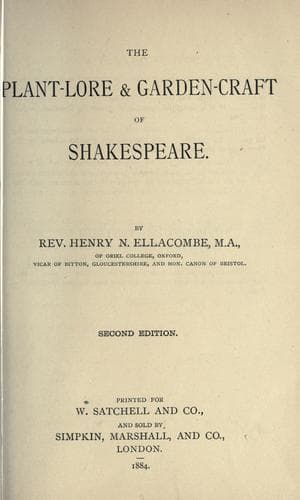
The plant-lore & garden-craft of ShakespeareEllacombe, Henry Nicholson
General
The plant-lore & garden-craft of Shakespeare
Ellacombe, Henry Nicholson
Gardens in literature; Plants in literature; Shakespeare, William, 1564-1616 -- Knowledge -- Botany
The following passage from Coles, in 1657, will illustrate No. 1: "In
Gloucestershire about Teuxbury they grind Mustard and make it into balls
which are brought to London and other remote places as being the best
that the world affords." These Mustard balls were the form in which
Mustard was usually sold, until Mrs. Clements, of Durham, in the last
century, invented the method of dressing mustard-flour, like
wheat-flour, and made her fortune with Durham Mustard; and it has been
supposed that this was the only form in which Mustard was sold in
Shakespeare's time, and that it was eaten dry as we eat pepper. But the
following from an Anglo-Saxon Leech-book seems to speak of it as used
exactly in the modern fashion. After mentioning several ingredients in a
recipe for want of appetite for meat, it says: "Triturate all
together--eke out with vinegar as may seem fit to thee, so that it may
be wrought into the form in which Mustard is tempered for flavouring,
put it then into a glass vessel, and then with bread, or with whatever
meat thou choose, lap it with a spoon, that will help" ("Leech Book,"
ii. 5, Cockayne's translation). And Parkinson's account is to the same
effect: "The seeds hereof, ground between two stones, fitted for the
purpose, and called a quern, with some good vinegar added to it to make
it liquid and running, is that kind of Mustard that is usually made of
all sorts to serve as sauce both for fish and flesh." And to the same
effect the "Boke of Nurture"--
"Yet make moche of Mustard, and put it not away,
For with every dische he is dewest who so lust to assay."
(L. 853).
MYRTLE.
(1) _Euphronius._
I was of late as petty to his ends
As is the morn-dew on the Myrtle-leaf
To his grand sea.
_Antony and Cleopatra_, act iii, sc. 12 (8).
(2) _Isabella._
Merciful Heaven,
Thou rather with thy sharp and sulphurous bolt
Split'st the unwedgeable and gnarled Oak
Than the soft Myrtle.
_Measure for Measure_, act ii, sc. 2 (114).
(3)
Venus, with young Adonis sitting by her,
Under a Myrtle shade began to woo him.
_Passionate Pilgrim_ (143).
(4)
Then sad she hasteth to a Myrtle grove.
_Venus and Adonis_ (865).
Public-domain text, read in full here on John Shaqi.
Reviews
Reviews
No reviews yet
Be the first to share your thoughts on this work.
Elsewhere in the archive
Join the Discussion
Join the discussion
Sign in to leave a comment or review.
Sign InorCreate an account