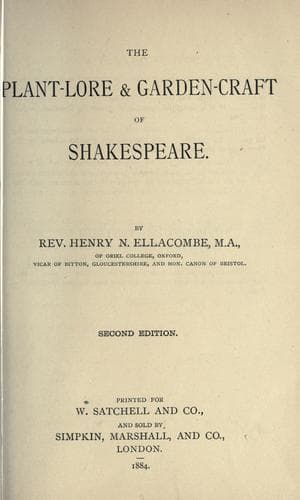
The plant-lore & garden-craft of ShakespeareEllacombe, Henry Nicholson
General
The plant-lore & garden-craft of Shakespeare
Ellacombe, Henry Nicholson
Gardens in literature; Plants in literature; Shakespeare, William, 1564-1616 -- Knowledge -- Botany
Myrtle is of course the English form of _myrtus_; but the older English
name was Gale, a name which is still applied to the bog-myrtle.[174:1]
Though a most abundant shrub in the South of Europe, and probably
introduced into England before the time of Shakespeare, the myrtle was
only grown in a very few places, and was kept alive with difficulty, so
that it was looked upon not only as a delicate and an elegant rarity,
but as the established emblem of refined beauty. In the Bible it is
always associated with visions and representations of peacefulness and
plenty, and Milton most fitly uses it in the description of our first
parents' "blissful bower"--
"The roofe
Of thickest covert was inwoven shade,
Laurel and Mirtle, and what higher grew
Of firm and fragrant leaf."
_Paradise Lost_, iv.
In heathen times the Myrtle was dedicated to Venus, and from this arose
the custom in mediæval times of using the flowers for bridal garlands,
which thus took the place of Orange blossoms in our time.
"The lover with the Myrtle sprays
Adorns his crisped cresses."
DRAYTON, _Muse's Elysium_.
"And I will make thee beds of Roses,
And a thousand fragrant posies,
A cap of flowers, and a kirtle
Embroidered o'er with leaves of Myrtle."
_Roxburghe Ballads._
As a garden shrub every one will grow the Myrtle that can induce it to
grow. There is no difficulty in its cultivation, provided only that the
climate suits it, and the climate that suits it best is the
neighbourhood of the sea. Virgil describes the Myrtles as "amantes
littora myrtos," and those who have seen the Myrtle as it grows on the
Devonshire and Cornish coasts will recognise the truth of his
description.
FOOTNOTES:
[174:1] "Gayle; mirtus."--_Catholicon Anglicum_, p. 147, with note.
NARCISSUS.
_Emilia._
This garden has a world of pleasures in't,
What flowre is this?
_Servant._
'Tis called Narcissus, madam.
_Emilia._
That was a faire boy certaine, but a foole,
To love himselfe; were there not maides enough?
_Two Noble Kinsmen_, act ii, sc. 2 (130).
_See_ DAFFODILS, p. 73.
NETTLES.
(1) _Cordelia._
Crown'd with rank Fumiter and Furrow-weeds,
With Burdocks, Hemlock, Nettles, Cuckoo-flowers.
_King Lear_, act iv, sc. 4. (3).
(2) _Queen._
Crow-flowers, Nettles, Daisies, and Long Purples.
_Hamlet_, act iv, sc. 7 (170).
(_See_ CROW-FLOWERS.)
(3) _Antonio._
He'd sow't with Nettle-seed.
_Tempest_, act ii, sc. 1 (145).
(4) _Saturninus._
Public-domain text, read in full here on John Shaqi.
Reviews
Reviews
No reviews yet
Be the first to share your thoughts on this work.
Elsewhere in the archive
Join the Discussion
Join the discussion
Sign in to leave a comment or review.
Sign InorCreate an account