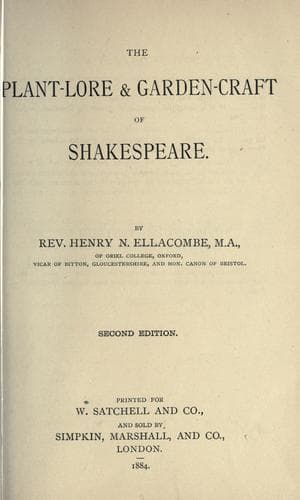
The plant-lore & garden-craft of ShakespeareEllacombe, Henry Nicholson
General
The plant-lore & garden-craft of Shakespeare
Ellacombe, Henry Nicholson
Gardens in literature; Plants in literature; Shakespeare, William, 1564-1616 -- Knowledge -- Botany
Both the Latin and English names of the plant record its qualities.
Urtica is from _uro_, to burn; and Nettle is (etymologically) the same
word as needle, and the plant is so named, not for its stinging
qualities, but because at one time the Nettle supplied the chief
instrument of sewing; not the instrument which holds the thread, and to
which we now confine the word needle, but the thread itself, and very
good thread it made. The poet Campbell says in one of his letters--"I
have slept in Nettle sheets, and dined off a Nettle table-cloth, and I
have heard my mother say that she thought Nettle cloth more durable than
any other linen." It has also been used for making paper, and for both
these purposes, as well as for rope-making, the Rhea fibre of the
Himalaya, which is simply a gigantic Nettle (_Urtica_ or _Böhmeria
nivea_), is very largely cultivated. Nor is the Nettle to be despised as
an article of food.[177:1] In many parts of England the young shoots are
boiled and much relished. In 1596 Coghan wrote of it: "I will speak
somewhat of the Nettle that Gardeners may understand what wrong they do
in plucking it for the weede, seeing it is so profitable to many
purposes. . . . Cunning cookes at the spring of the yeare, when Nettles
first bud forth, can make good pottage with them, especially with red
Nettles" ("Haven of Health," p. 86). In February, 1661, Pepys made the
entry in his diary--"We did eat some Nettle porridge, which was made on
purpose to-day for some of their coming, and was very good." Andrew
Fairservice said of himself--"Nae doubt I should understand my trade of
horticulture, seeing I was bred in the Parish of Dreepdaily, where they
raise lang Kale under glass, and force the early Nettles for their
spring Kale" ("Rob Roy," c. 7). Gipsies are said to cook it as an
excellent vegetable, and M. Soyer tried hard, but almost in vain, to
recommend it as a most dainty dish. Having so many uses, we are not
surprised to find that it has at times been regularly cultivated as a
garden crop, so that I have somewhere seen an account of tithe of
Nettles being taken; and in the old churchwardens' account of St.
Michael's, Bath, is the entry in the year 1400, "Pro Urticis venditis ad
Lawrencium Bebbe, 2d."
Nettles are much used in the neighbourhood of London to pack plums and
other fruit with bloom on them, so that in some market gardens they are
not only not destroyed, but encouraged, and even cultivated. And this
is an old practice; Lawson's advice in 1683 was--"For the gathering of
all other stone-fruit, as Nectarines, Apricots, Peaches, Pear-plums,
Damsons, Bullas, and such like, . . . in the bottom of your large sives
where you put them, you shall lay Nettles, and likewise in the top, for
that will ripen those that are most unready" ("New Orchard," p. 96).
Public-domain text, read in full here on John Shaqi.
Reviews
Reviews
No reviews yet
Be the first to share your thoughts on this work.
Elsewhere in the archive
Join the Discussion
Join the discussion
Sign in to leave a comment or review.
Sign InorCreate an account