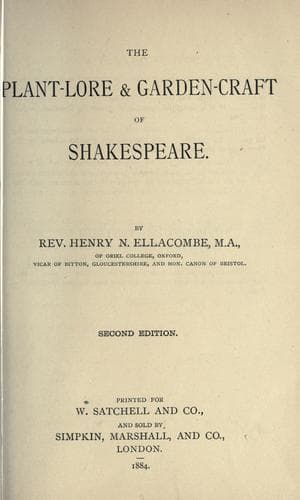
The plant-lore & garden-craft of ShakespeareEllacombe, Henry Nicholson
General
The plant-lore & garden-craft of Shakespeare
Ellacombe, Henry Nicholson
Gardens in literature; Plants in literature; Shakespeare, William, 1564-1616 -- Knowledge -- Botany
The "Nettle of India" (No. 5) has puzzled the commentators. It is
probably not the true reading; if the true reading, it may only mean a
Nettle of extra-stinging quality; but it may also mean an Eastern plant
that was used to produce cowage, or cow-itch. "The hairs of the pods of
Mucuna pruriens, &c., constitute the substance called cow-itch, a
mechanical Anthelmintic."--LINDLEY. This plant is said to have been
called the Nettle of India, but I do not find it so named in
Shakespeare's time.
In other points the Nettle is a most interesting plant. Microscopists
find in it most beautiful objects for the microscope; entomologists
value it, for it is such a favourite of butterflies and other insects,
that in Britain alone upwards of thirty insects feed solely on the
Nettle plant, and it is one of those curious plants which mark the
progress of civilization by following man wherever he goes.[178:1]
But as a garden plant the only advice to be given is to keep it out of
the garden by every means. In good cultivated ground it becomes a sad
weed if once allowed a settlement. The Himalayan Böhmerias, however, are
handsome, but only for their foliage; and though we cannot, perhaps,
admit our roadside Dead Nettles, which however are much handsomer than
many foreign flowers which we carefully tend and prize, yet the Austrian
Dead Nettle (_Lamium orvala_, "Bot. Mag.," v. 172) may be well admitted
as a handsome garden plant.
FOOTNOTES:
[176:1] This a modern reading; the correct reading is "metal."
[177:1]
"Si forte in medio positorum abstemius herbis
Vivis et Urtica."--HORACE, _Ep._ i, 10, 8.
"Mihi festa luce coquatar Urtica."--PERSIUS vi, 68.
[178:1] "L'ortie s'établit partout dans les contrées temperées à la
suite de l'homme pour disparaitre bientôt si le lieu on elle s'est ainsi
implanteè cesse d'etre habité."--M. LAVAILLEE, _Sur les Arbres_, &c.,
1878.
NUT, _see_ HAZEL.
NUTMEG.
(1) _Dauphin._
He's [the horse] of the colour of the Nutmeg.
_Henry V_, act iii, sc. 7 (20).
(2) _Clown._
I must have . . . Nutmegs Seven.
_Winter's Tale_, act iv, sc. 3 (50).
(3) _Armado._
The omnipotent Mars, of lances the almighty,
Gave Hector a gift--
_Dumain._
A gilt Nutmeg.
_Love's Labour's Lost_, act v, sc. 2 (650).
Gerard gives a very fair description of the Nutmeg tree under the names
of Nux moschata or Myristica; but it is certain that he had not any
personal knowledge of the tree, which was not introduced into England or
Europe for nearly 200 years after. Shakespeare could only have known the
imported Nut and the Mace which covers the Nut inside the shell, and
they were imported long before his time. Chaucer speaks of it as--
"Notemygge to put in ale
Whether it be moist or stale,
Or for to lay in cofre."--_Sir Thopas._
And in another poem we have--
Public-domain text, read in full here on John Shaqi.
Reviews
Reviews
No reviews yet
Be the first to share your thoughts on this work.
Elsewhere in the archive
Join the Discussion
Join the discussion
Sign in to leave a comment or review.
Sign InorCreate an account