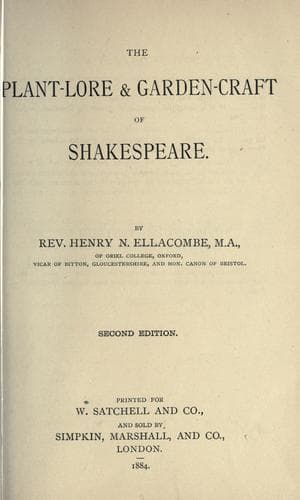
The plant-lore & garden-craft of ShakespeareEllacombe, Henry Nicholson
General
The plant-lore & garden-craft of Shakespeare
Ellacombe, Henry Nicholson
Gardens in literature; Plants in literature; Shakespeare, William, 1564-1616 -- Knowledge -- Botany
(1) _Bottom._
And, most dear actors, eat no Onions nor
Garlic, for we are to utter sweet breath.
_Midsummer Night's Dream_, act iv, sc. 2 (42).
(2) _Lafeu._
Mine eyes smell Onions, I shall weep anon:
Good Tom Drum, lend me a handkercher.
_All's Well that Ends Well_, act v, sc. 3 (321).
(3) _Enobarbus._
Indeed the tears live in Onion that should water this Sorrow.
_Antony and Cleopatra_, act i, sc. 2 (176).
(4) _Enobarbus._
Look, they weep,
And I, an ass, am Onion-eyed.
_Ibid._, act iv, sc. 2 (34).
(5) _Lord._
And if the boy have not a woman's gift
To rain a shower of commanded tears,
An Onion will do well for such a shift,
Which in a napkin being close conveyed
Shall in despite enforce a watery eye.
_Taming of the Shrew_, Induction, sc. 1 (124).
There is no need to say much of the Onion in addition to what I have
already said on the Garlick and Leek, except to note that Onions seem
always to have been considered more refined food than Leek and Garlick.
Homer makes Onions an important part of the elegant little repast which
Hecamede set before Nestor and Machaon--
"Before them first a table fair she spread,
Well polished and with feet of solid bronze;
On this a brazen canister she placed,
And Onions as a relish to the wine,
And pale clear honey and pure Barley meal."
_Iliad_, book xi. (Lord Derby's translation).
But in the time of Shakespeare they were not held in such esteem.
Coghan, writing in 1596, says of them: "Being eaten raw, they engender
all humourous and corruptible putrifactions in the stomacke, and cause
fearful dreames, and if they be much used they snarre the memory and
trouble the understanding" ("Haven of Health," p. 58).
The name comes directly from the French _oignon_, a bulb, being the bulb
_par excellence_, the French name coming from the Latin _unio_, which
was the name given to some species of Onion, probably from the bulb
growing singly. It may be noted, however, that the older English name
for the Onion was Ine, of which we may perhaps still have the
remembrance in the common "Inions." The use of the Onion to promote
artificial crying is of very old date, Columella speaking of "lacrymosa
cæpe," and Pliny of "cæpis odor lacrymosus." There are frequent
references to the same use in the old English writers.
The Onion has been for so many centuries in cultivation that its native
home has been much disputed, but it has now "according to Dr. Regel
('Gartenflora,' 1877, p. 264) been definitely determined to be the
mountains of Central Asia. It has also been found in a wild state in the
Himalaya Mountains."--_Gardener's Chronicle._
ORANGE.
(1) _Beatrice._
Public-domain text, read in full here on John Shaqi.
Reviews
Reviews
No reviews yet
Be the first to share your thoughts on this work.
Elsewhere in the archive
Join the Discussion
Join the discussion
Sign in to leave a comment or review.
Sign InorCreate an account