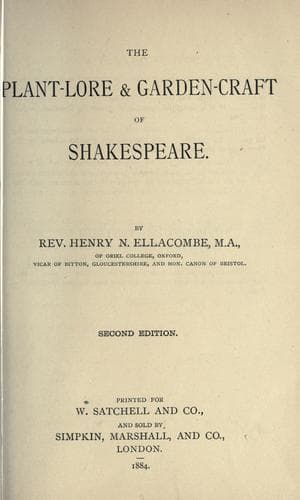
The plant-lore & garden-craft of ShakespeareEllacombe, Henry Nicholson
General
The plant-lore & garden-craft of Shakespeare
Ellacombe, Henry Nicholson
Gardens in literature; Plants in literature; Shakespeare, William, 1564-1616 -- Knowledge -- Botany
The count is neither sad nor sick, nor merry nor well; but
civil count, civil as an Orange, and something of that
jealous complexion.
_Much Ado About Nothing_, act ii, sc. 1 (303).
(2) _Claudio._
Give not this rotten Orange to your friend.
_Much Ado About Nothing_, act iv, sc. 1 (33).
(3) _Bottom._
I will discharge it either in your straw-coloured beard, your
Orange-tawny beard.
_Midsummer Night's Dream_, act i, sc. 2 (95).
(4) _Bottom._
The ousel cock so black of hue
With Orange-tawny bill.
_Ibid._, act iii, sc. 1 (128).
(5) _Menenius._
You wear out a good wholesome forenoon in hearing a cause
between an Orange-wife and a fosset-seller.
_Coriolanus_, act ii, sc. 1 (77).
I should think it very probable that Shakespeare may have seen both
Orange and Lemon trees growing in England. The Orange is a native of the
East Indies, and no certain date can be given for its introduction into
Europe. Under the name of the Median Apple a tree is described first by
Theophrastus, and then by Virgil and Palladius, which is supposed by
some to be the Orange; but as they all describe it as unfit for food, it
is with good reason supposed that the tree referred to is either the
Lemon or Citron. Virgil describes it very exactly--
"Ipsa ingens arbor, faciemque simillima lauro
Et si non alium late jactaret odorem
Laurus erat; folia hand ullis labentia ventis
Flos ad prima tenax."--_Georgic_ ii, 131.
Public-domain text, read in full here on John Shaqi.
Reviews
Reviews
No reviews yet
Be the first to share your thoughts on this work.
Elsewhere in the archive
Join the Discussion
Join the discussion
Sign in to leave a comment or review.
Sign InorCreate an account