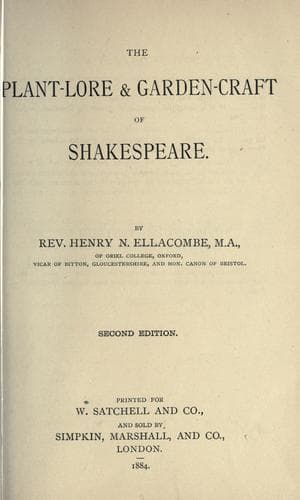
The plant-lore & garden-craft of ShakespeareEllacombe, Henry Nicholson
General
The plant-lore & garden-craft of Shakespeare
Ellacombe, Henry Nicholson
Gardens in literature; Plants in literature; Shakespeare, William, 1564-1616 -- Knowledge -- Botany
_Midsummer Night's Dream_, act ii, sc. 1 (249).
(3)
Oxlips in their cradles growing.
_Two Noble Kinsmen_, Intro. song.
The true Oxlip (_Primula eliator_) is so like both the Primrose and
Cowslip that it has been by many supposed to be a hybrid between the
two. Sir Joseph Hooker, however, considers it a true species. It is a
handsome plant, but it is probably not the "bold Oxlip" of Shakespeare,
or the plant which is such a favourite in cottage gardens. The true
Oxlip (P. elatior of Jacquin) is an eastern counties' plant; while the
common forms of the Oxlip are hybrids between the Cowslip and Primrose.
(_See_ COWSLIP and PRIMROSE.)
PALM TREE.
(1) _Rosalind._
Look here what I found on a Palm tree.
_As You Like It_, act iii, sc. 2 (185).
(2) _Hamlet._
As love between them like the Palm might flourish.
_Hamlet_, act v, sc. 2 (40).
(3) _Volumnia._
And bear the Palm for having bravely shed
Thy wife and children's blood.
_Coriolanus_, act v, sc. 3 (117).
(4) _Cassius._
And bear the Palm alone.
_Julius Cæsar_, act i, sc. 2 (131).
(5) _Painter._
You shall see him a Palm in Athens again, and flourish with
the highest.
_Timon of Athens_, act v, sc. 1 (12).
(6)
_The Vision._--Enter, solemnly tripping one after another,
six personages, clad in white robes, wearing on their
heads garlands of Bays, and golden vizards on their faces,
branches of Bays or Palm in their hands.
_Henry VIII_, act iv, sc. 2.
To these passages may be added the following, in which the Palm tree is
certainly alluded to though it is not mentioned by name--
_Sebastian._
That in Arabia
There is one tree, the Phœnix' throne; one Phœnix
At this hour reigning there.
_Tempest_, act iii, sc. 3 (22).[193:1]
And from the poem by Shakespeare, published in Chester's "Love's
Martyr," 1601.
"Let the bird of loudest lay
On the sole Arabian tree
Herald sad and Trumpet be,
To whose sound chaste wings obey."
Public-domain text, read in full here on John Shaqi.
Reviews
Reviews
No reviews yet
Be the first to share your thoughts on this work.
Elsewhere in the archive
Join the Discussion
Join the discussion
Sign in to leave a comment or review.
Sign InorCreate an account