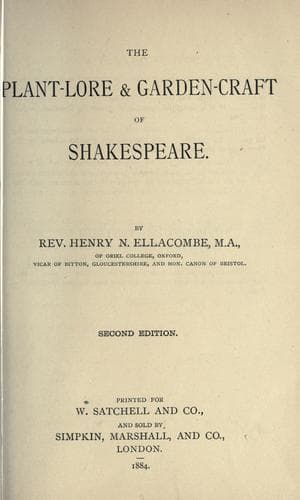
The plant-lore & garden-craft of ShakespeareEllacombe, Henry Nicholson
General
The plant-lore & garden-craft of Shakespeare
Ellacombe, Henry Nicholson
Gardens in literature; Plants in literature; Shakespeare, William, 1564-1616 -- Knowledge -- Botany
Two very distinct trees are named in these passages. In the last five
the reference is to the true Palm of Biblical and classical fame, as the
emblem of victory, and the typical representation of life and beauty in
the midst of barren waste and deserts. And we are not surprised at the
veneration in which the tree was held, when we consider either the
wonderful grace of the tree, or its many uses in its native countries,
so many, that Pliny says that the Orientals reckoned 360 uses to which
the Palm tree could be applied. Turner, in 1548, said: "I never saw any
perfit Date tree yet, but onely a little one that never came to
perfection;"[194:1] and whether Shakespeare ever saw a living Palm tree
is doubtful, but he may have done so. (_See_ DATE.) Now there are a
great number grown in the large houses of botanic and other gardens, the
Palm-house at Kew showing more and better specimens than can be seen in
any other collection in Europe: even the open garden can now boast of a
few species that will endure our winters without protection. Chamærops
humilis and Fortunei seem to be perfectly hardy, and good specimens may
be seen in several gardens; Corypha australis is also said to be quite
hardy, and there is little doubt but that the Date Palm (_Phœnix
dactylifera_), which has long been naturalized in the South of Europe,
would live in Devonshire and Cornwall, and that of the thousand species
of Palms growing in so many different parts of the world, some will yet
be found that may grow well in the open air in England.
But the Palm tree in No. 1 is a totally different tree, and much as
Shakespeare has been laughed at for placing a Palm tree in the Forest of
Arden, the laugh is easily turned against those who raise such an
objection. The Palm tree of the Forest of Arden is the
"Satin-shining Palm
On Sallows in the windy gleams of March"--
_Idylls of the King_--Vivien.
that is, the Early Willow (_Salix caprea_) and I believe it is so called
all over England, as it is in Northern Germany, and probably in other
northern countries. There is little doubt that the name arose from the
custom of using the Willow branches with the pretty golden catkins on
Palm Sunday as a substitute for Palm branches.
"In Rome upon Palm Sunday they bear true Palms,
The Cardinals bow reverently and sing old Psalms;
Elsewhere those Psalms are sung 'mid Olive branches,
The Holly branch supplies the place among the avalanches;
More northern climes must be content with the sad Willow."
GOETHE (quoted by Seeman).
Public-domain text, read in full here on John Shaqi.
Reviews
Reviews
No reviews yet
Be the first to share your thoughts on this work.
Elsewhere in the archive
Join the Discussion
Join the discussion
Sign in to leave a comment or review.
Sign InorCreate an account