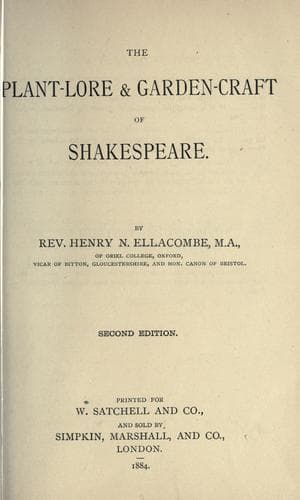
The plant-lore & garden-craft of ShakespeareEllacombe, Henry Nicholson
General
The plant-lore & garden-craft of Shakespeare
Ellacombe, Henry Nicholson
Gardens in literature; Plants in literature; Shakespeare, William, 1564-1616 -- Knowledge -- Botany
Yet mark'd I where the bolt of Cupid fell:
It fell upon a little western flower,
Before milk-white, now purple with love's wound,
And maidens call it Love-in-idleness.
Fetch me that flower; the herb I show'd thee once;
The juice of it on sleeping eye-lids laid
Will make or man or woman madly dote
Upon the next live creature that it sees.
_Midsummer Night's Dream_, act ii, sc. 1 (165).
(4) _Oberon._
Dian's Bud o'er Cupid's flower
Hath such free and blessed power.
_Ibid._, act iv, sc. 1 (78).
The Pansy is one of the oldest favourites in English gardens, and the
affection for it is shown in the many names that were given to it. The
Anglo-Saxon name was Banwort or Bonewort, though why such a name was
given to it we cannot now say. Nor can we satisfactorily explain its
common names of Pansy or Pawnce (from the French, _pensées_--"that is,
for thoughts," says Ophelia), or Heart's-ease,[196:1] which name was
originally given to the Wallflower. The name Cupid's flower seems to be
peculiar to Shakespeare, but the other name, Love-in-idle, or idleness,
is said to be still in use in Warwickshire, and signifies love in vain,
or to no purpose, as in Chaucer: "The prophet David saith; If God ne
kepe not the citee, in ydel waketh he that keptit it."[196:2] And in
Tyndale's translation of the New Testament, "I have prechid to you, if
ye holden, if ye hav not bileved ideli" (1 Cor. xv. 2). "Beynge
plenteuous in werk of the Lord evermore, witynge that youre traveil is
not idel in the Lord" (1 Cor. xv. 58).
But beside these more common names, Dr. Prior mentions the following:
"Herb Trinity, Three faces under a hood, Fancy, Flamy,[197:1] Kiss me,
Cull me or Cuddle me to you, Tickle my fancy, Kiss me ere I rise, Jump
up and kiss me, Kiss me at the garden gate, Pink of my John, and several
more of the same amatory character."
Spenser gives the flower a place in his "Royal aray" for Elisa--
"Strowe me the grounde with Daffadowndillies,
And Cowslips, and Kingcups, and loved Lillies,
The pretie Pawnce,
And the Chevisaunce
Shall match with the fayre Flower Delice."
And in another place he speaks of the "Paunces trim"--_F. Q._, iii. 1.
Milton places it in Eve's couch--
"Flowers were the couch,
Pansies, and Violets, and Asphodel,
And Hyacinth, earth's freshest, softest lap."
He names it also as part of the wreath of Sabrina--
"Pansies, Pinks, and gaudy Daffadils;"
and as one of the flowers to strew the hearse of Lycidas--
"The White Pink and the Pansie streaked with jet,
The glowing Violet."
FOOTNOTES:
[196:1] "The Pansie Heart's ease Maiden's call."--DRAYTON _Ed._, ix.
[196:2] And again--
"The other heste of hym is this,
Take not in ydel my name or amys."
_Pardeners Tale._
Public-domain text, read in full here on John Shaqi.
Reviews
Reviews
No reviews yet
Be the first to share your thoughts on this work.
Elsewhere in the archive
Join the Discussion
Join the discussion
Sign in to leave a comment or review.
Sign InorCreate an account