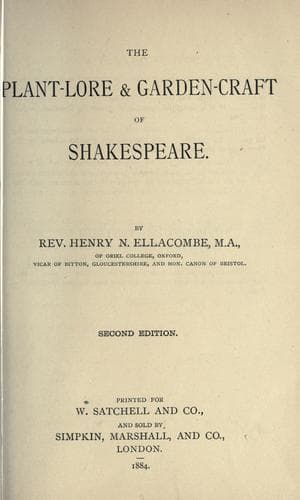
The plant-lore & garden-craft of ShakespeareEllacombe, Henry Nicholson
General
The plant-lore & garden-craft of Shakespeare
Ellacombe, Henry Nicholson
Gardens in literature; Plants in literature; Shakespeare, William, 1564-1616 -- Knowledge -- Botany
But besides Willow branches, Yew branches are sometimes used for the
same purpose, and so we find Yews called Palms. Evelyn says they were so
called in Kent; they are still so called in Ireland, and in the
churchwarden's accounts of Woodbury, Devonshire, is the following entry:
"Memorandum, 1775. That a Yew or Palm tree was planted in the
churchyard, ye south side of the church, in the same place where one was
blown down by the wind a few days ago, this 25th of November."[195:1]
How Willow or Yew branches could ever have been substituted for such a
very different branch as a Palm it is hard to say, but in lack of a
better explanation, I think it not unlikely that it might have arisen
from the direction for the Feast of Tabernacles in Leviticus xxiii. 40:
"Ye shall take you on the first day the boughs of goodly trees, the
branches of Palm trees, and the boughs of thick trees, and Willows of
the brook." But from whatever cause the name and the custom was derived,
the Willow was so named in very early times, and in Shakespeare's time
the name was very common. Here is one instance among many--
"Lambs frisk and play, the shepherds pipe all day,
The Palms and May make country houses gay,
And we hear aye birds tune this merry lay--
Cuckoo, jug-jug, pee-we, to-witta-woo."
T. NASH. 1567-1601.
FOOTNOTES:
[193:1] I do not include among "Palms" the passage in _Hamlet_, act i,
sc. 1: "In the most high and palmy state of Rome," because I bow to
Archdeacon Nares' judgment that "palmy" here means "grown to full
height, in allusion to the palms of the stag's horns, when they have
attained to their utmost growth." He does not, however, decide this with
certainty, and the question may be still an open one.
[194:1] "Names of Herbes," s.v. Palma.
[195:1] In connection with this, Turner's account of the Palm in 1538 is
worth quoting: "Palmā arborem in anglia nunq' me vidisse memini. Indie
tamen ramis palmarū (ut illi loqūntur) sœpius sacerdotē dicentē andivi.
Bendic etiā et hos palmarū ramos, quū prœter salignas frondes nihil
omnino viderē ego, quid alii viderint nescio. Si nobis palmarum frondes
non suppeterent; prœstaret me judice mutare lectionem et dicere. Benedic
hos salicū ramos q' falso et mendaciter salicum frondes palmarum frondes
vocare."--LIBELLUS, _De re Herbaria_, s.v. Palma.
PANSIES.
(1) _Ophelia._
And there is Pansies--that's for thoughts.
_Hamlet_, act iv, sc. 5 (176).
(2) _Lucentio._
But see, while idly I stood looking on,
I found the effect of Love-in-idleness.
_Taming of the Shrew_, act i, sc. 1 (155).
(3) _Oberon._
Public-domain text, read in full here on John Shaqi.
Reviews
Reviews
No reviews yet
Be the first to share your thoughts on this work.
Elsewhere in the archive
Join the Discussion
Join the discussion
Sign in to leave a comment or review.
Sign InorCreate an account