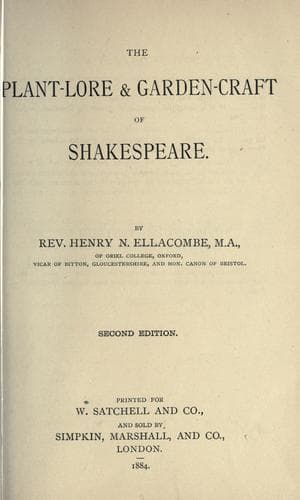
The plant-lore & garden-craft of ShakespeareEllacombe, Henry Nicholson
General
The plant-lore & garden-craft of Shakespeare
Ellacombe, Henry Nicholson
Gardens in literature; Plants in literature; Shakespeare, William, 1564-1616 -- Knowledge -- Botany
The native country of the Peach is now ascertained to be China, and
not Persia, as the name would imply. It probably came to the Romans
through Persia, and was by them introduced into England. It occurs in
Archbishop's Ælfric's "Vocabulary" in the tenth century, "Persicarius,
Perseoctreow;" and John de Garlande grew it in the thirteenth century,
"In virgulto Magistri Johannis, pessicus fert pessica." It is named in
the "Promptorium Parvulorum" as "Peche, or Peske, frute--Pesca Pomum
Persicum;" and in a note the Editor says: "In a role of purchases for
the Palace of Westminster preserved amongst the miscellaneous record of
the Queen's remembrance, a payment occurs, Will le Gardener, pro iij
koygnere, ij pichere iij_s._--pro groseillere iij_d_, pro j peschere
vj_d._" A.D. 1275, 4 Edw: 1--
We all know and appreciate the fruit of the Peach, but few seem to know
how ornamental a tree is the Peach, quite independent of the fruit. In
those parts where the soil and climate are suitable, the Peach may be
grown as an ornamental spring flowering bush. When so grown preference
is generally given to the double varieties, of which there are several,
and which are not by any means the new plants that they are generally
supposed to be, as they were cultivated both by Gerard and Parkinson.
PEAR.
(1) _Falstaff._
I warrant they would whip me with their fine wits till I were
as crest-fallen as a dried Pear.
_Merry Wives of Windsor_, act iv, sc. 5 (101).
(2) _Parolles._
Your virginity, your old virginity, is like one of our French
withered Pears, it looks ill, it eats drily; marry, 'tis a
withered Pear; it was formerly better; marry, yet 'tis a
withered Pear.
_All's Well that Ends Well_, act i, sc. 1 (174).
(3) _Clown._
I must have Saffron to colour the Warden pies.
_Winter's Tale_, act iv, sc. 3 (48).
(4) _Mercutio._
O, Romeo . . . thou a Poperin Pear.
_Romeo and Juliet_, act ii, sc. 1 (37).
If we may judge by these few notices, Shakespeare does not seem to have
had much respect for the Pear, all the references to the fruit being
more or less absurd or unpleasant. Yet there were good Pears in his day,
and so many different kinds that Gerard declined to tell them at length,
for "the stocke or kindred of Pears are not to be numbered; every
country hath his peculiar fruit, so that to describe them apart were to
send an owle to Athens, or to number those things that are without
number."
Public-domain text, read in full here on John Shaqi.
Reviews
Reviews
No reviews yet
Be the first to share your thoughts on this work.
Elsewhere in the archive
Join the Discussion
Join the discussion
Sign in to leave a comment or review.
Sign InorCreate an account