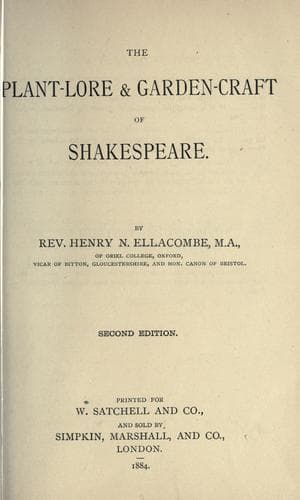
The plant-lore & garden-craft of ShakespeareEllacombe, Henry Nicholson
General
The plant-lore & garden-craft of Shakespeare
Ellacombe, Henry Nicholson
Gardens in literature; Plants in literature; Shakespeare, William, 1564-1616 -- Knowledge -- Botany
Of these many sorts Shakespeare mentions by name but two, the Warden and
the Poperin, and it is not possible to identify these with modern
varieties with any certainty. The Warden was probably a general name for
large keeping and stewing Pears, and the name was said to come from the
Anglo-Saxon _wearden_, to keep or preserve, in allusion to its lasting
qualities. But this is certainly a mistake. In an interesting paper by
Mr. Hudson Turner, "On the State of Horticulture in England in early
times, chiefly previous to the fifteenth century," printed in the
"Archæological Journal," vol. v. p. 301, it is stated that "the Warden
Pear had its origin and its name from the horticultural skill of the
Cistercian Monks of Wardon Abbey in Bedfordshire, founded in the twelfth
century. Three Warden Pears appeared in the armorial bearings of the
Abbey."
It was certainly an early name. In the "Catholicon Anglicum" we find: "A
Parmayn, volemum, Anglice, a Warden;" and in Parkinson's time the name
was still in use, and he mentions two varieties, "The Warden or
Lukewards Pear are of two sorts, both white and red, both great and
small." (The name of Lukewards seems to point to St. Luke's Day, October
18, as perhaps the time either for picking the fruit or for its
ripening.) "The Spanish Warden is greater than either of both the
former, and better also." And he further says: "The Red Warden and the
Spanish Warden are reckoned amongst the most excellent of Pears, either
to bake or to roast, for the sick or for the sound--and indeed the
Quince and the Warden are the only two fruits that are permitted to the
sick to eat at any time." The Warden pies of Shakespeare's day, coloured
with Saffron, have in our day been replaced by stewed Pears coloured
with Cochineal.[200:1]
I can find no guide to the identification of the Poperin Pear, beyond
Parkinson's description: "The summer Popperin and the winter Popperin,
both of them very good, firm, dry Pears, somewhat spotted and brownish
on the outside. The green Popperin is a winter fruit of equal goodnesse
with the former." It was probably a Flemish Pear, and may have been
introduced by the antiquary Leland, who was made Rector of Popering by
Henry VIII. The place is further known to us as mentioned by Chaucer--
"A knyght was fair and gent
In batail and in tornament,
His name was Sir Thopas.
Alone he was in fer contre,
In Flaundres, all beyonde the se,
At Popering in the place."
Public-domain text, read in full here on John Shaqi.
Reviews
Reviews
No reviews yet
Be the first to share your thoughts on this work.
Elsewhere in the archive
Join the Discussion
Join the discussion
Sign in to leave a comment or review.
Sign InorCreate an account