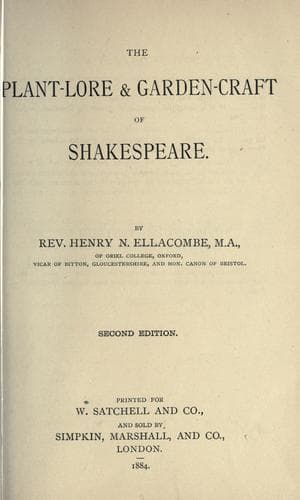
The plant-lore & garden-craft of ShakespeareEllacombe, Henry Nicholson
General
The plant-lore & garden-craft of Shakespeare
Ellacombe, Henry Nicholson
Gardens in literature; Plants in literature; Shakespeare, William, 1564-1616 -- Knowledge -- Botany
[211:2] The name was variously spelt, _e.g._--
"And other trees there was mane one
The Pyany, the Poplar, and the Plane."
_The Squyr of Lowe Degre_, 39.
"The pretie Pinke and purple Pianet."
CUTWODE, _Caltha Poetarum_, 1599, st. 24.
"A Pyon (Pyion A.) dionia, herba est."--_Catholicon Anglicum._
PIPPIN, _see_ APPLE.
PLANE.
_Daughter._
I have sent him where a Cedar,
Higher than all the rest, spreads like a Plane
Fast by a brook.
_Two Noble Kinsmen_, act ii, sc. 6 (4).
There is no certain record how long the Plane has been introduced into
England; it is certainly not a native tree, nor even an European tree,
but came from the East, and was largely planted and much admired both by
the Greeks and Romans. We know from Pliny that it was growing in France
in his day on the part opposite Britain, and the name occurs in the old
vocabularies. But from Turner's evidence in 1548 it must have been a
very scarce tree in the sixteenth century. He says: "I never saw any
Plaine tree in Englande, saving once in Northumberlande besyde Morpeth,
and an other at Barnwell Abbey besyde Cambryge." And more than a hundred
years later Evelyn records a special visit to Lee to inspect one as a
great curiosity. The Plane is not only a very handsome tree, and a fast
grower, but from the fact that it yearly sheds its bark it has become
one of the most useful trees for growing in towns. The wood is of very
little value. To the emblem writers the Plane was an example of
something good to the eye, but of no real use. Camerarius so moralizes
it (Pl. xix.), and, quoting Virgil's "steriles platanos," he says of it,
"umbram non fructum platanus dat."
PLANTAIN.
(1) _Costard._
O sir, Plantain, a plain Plantain! no l'envoy, no l'envoy; no
salve, sir, but a Plantain.
* * * * *
_Moth._
By saying that a costard was broken in a shin.
Then call'd you for the l'envoy.
_Costard._
True! and I for a Plantain.
_Loves Labour's Lost_, act iii, sc. 1 (76).
(2) _Romeo._
Your Plantain leaf is excellent for that.
_Benvolio._
For what, I pray thee?
_Romeo._
For your broken shin.
_Romeo and Juliet_, act i, sc. 2 (52).
(3) _Troilus._
As true as steel, as Plantage to the moon.
_Troilus and Cressida_, act iii, sc. 2 (184).
(4) _Palamon._
These poore slight sores
Neede not a Plantin.
_Two Noble Kinsmen_, act i, sc. 2 (65).
Public-domain text, read in full here on John Shaqi.
Reviews
Reviews
No reviews yet
Be the first to share your thoughts on this work.
Elsewhere in the archive
Join the Discussion
Join the discussion
Sign in to leave a comment or review.
Sign InorCreate an account