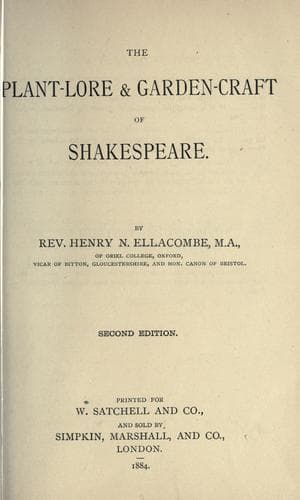
The plant-lore & garden-craft of ShakespeareEllacombe, Henry Nicholson
General
The plant-lore & garden-craft of Shakespeare
Ellacombe, Henry Nicholson
Gardens in literature; Plants in literature; Shakespeare, William, 1564-1616 -- Knowledge -- Botany
The Pæony (_P. corallina_) is sometimes allowed a place in the British
flora, having been found apparently wild at the Steep Holmes in the
Bristol Channel and a few other places, but it is now considered
certain that in all these places it is a garden escape. Gerard gave one
such habitat: "The male Peionie groweth wilde upon a Coneyberry in
Betsome, being in the parish of Southfleet, in Kent, two miles from
Gravesend, and in the ground sometimes belonging to a farmer there,
called John Bradley;" but on this his editor adds the damaging note: "I
have been told that our author himselfe planted that Peionee there, and
afterwards seemed to find it there by accident; and I do believe it was
so, because none before or since have ever seen or heard of it growing
wild since in any part of this kingdome."
But though not a native plant, it had been cultivated in England long
before Shakespeare's and Gerard's time. It occurs in most of the old
vocabularies from the tenth century downwards, and in Shakespeare's time
the English gardens had most of the European species that are now grown,
including also the handsome double-red and white varieties. Since his
time the number of species and varieties has been largely increased by
the addition of the Chinese and Japanese species, and by the labours of
the French nurserymen, who have paid more attention to the flower than
the English.
In the hardy flower garden there is no more showy family than the Pæony.
They have flowers of many colours, from almost pure white and pale
yellow to the richest crimson; and they vary very much in their foliage,
most of them having large fleshy leaves, "not much unlike the leaves of
the Walnut tree," but some of them having their leaves finely cut and
divided almost like the leaves of Fennel (_P. tenuifolia_). They further
vary in that some are herbaceous, disappearing entirely in winter, while
others, Moutan or Tree Pæonies, are shrubs; and in favourable seasons,
when the shrub is not injured by spring frosts, there is no grander
shrub than an old Tree Pæony in full flower.
Of the many different species the best are the Moutans, which, according
to Chinese tradition, have been grown in China for 1500 years, and which
are now produced in great variety of colour; P. corallina, for the
beauty of its coral-like seeds; P. Cretica, for its earliness in
flowering; P. tenuifolia, single and double, for its elegant foliage; P.
Whitmaniana, for its pale yellow but very fleeting flowers, which,
before they are fully expanded, have all the appearance of immense
Globe-flowers (_trollius_); P. lobata, for the wonderful richness of its
bright crimson flowers; and P. Whitleji, a very old and very double form
of P. edulis, of great size, and most delicate pink and white colour.
FOOTNOTES:
[211:1]
"Which to outbarre, with painful pyonings,
From sea to sea, he heapt a mighty mound!"
SPENSER, _F. Q._, ii, 10, 46.
Public-domain text, read in full here on John Shaqi.
Reviews
Reviews
No reviews yet
Be the first to share your thoughts on this work.
Elsewhere in the archive
Join the Discussion
Join the discussion
Sign in to leave a comment or review.
Sign InorCreate an account