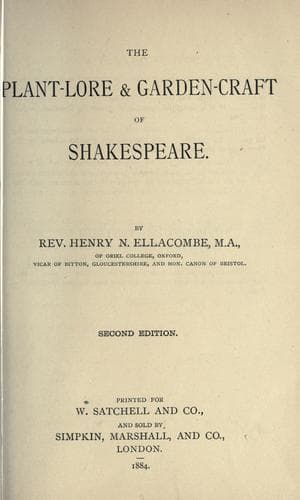
The plant-lore & garden-craft of ShakespeareEllacombe, Henry Nicholson
General
The plant-lore & garden-craft of Shakespeare
Ellacombe, Henry Nicholson
Gardens in literature; Plants in literature; Shakespeare, William, 1564-1616 -- Knowledge -- Botany
I will dance and eat Plums at your wedding.
_Merry Wives of Windsor_, act v, sc. 5.[217:1]
(5)
The mellow Plum doth fall, the green sticks fast,
Or, being early pluck'd, is sour to taste.
_Venus and Adonis_ (527).
(6)
Like a green Plum that hangs upon a tree,
And falls, through wind, before the fall should be.
_Passionate Pilgrim_ (135).
(7) _Slender._
Three veneys for a dish of stewed Prunes.
_Merry Wives of Windsor_, act i, sc. 1 (295).
(8) _Falstaff._
There's no more faith in thee than in a stewed Prune.
_1st Henry IV_, act iii, sc. 3 (127).
(9) _Pompey._
Longing (saving your honour's presence) for stewed Prunes.
* * * * *
And longing, as I said, for Prunes.
* * * * *
You being then, if you he remembered, cracking the stones of
the foresaid Prunes.
_Measure for Measure_, act ii, sc. 1 (92).
(10) _Clown._
Four pounds of Prunes, and as many of Raisins of the sun.
_Winters Tale_, act iv, sc. 3 (51).
(11) _Falstaff._
Hang him, rogue; he lives upon mouldy stewed Prunes and dried
cakes.
_2nd Henry IV_, act ii, sc. 4 (158).
Plums, Damsons, and Prunes may conveniently be joined together, Plums
and Damsons being often used synonymously (as in No. 3), and Prunes
being the dried Plums. The Damsons were originally, no doubt, a good
variety from the East, and nominally from Damascus.[217:2] They seem to
have been considered great delicacies, as in a curious allegorical
drama of the fifteenth century, called "La Nef de Sante," of which an
account is given by Mr. Wright: "Bonne-Compagnie, to begin the day,
orders a collation, at which, among other things, are served Damsons
(_Prunes de Damas_), which appear at this time to have been considered
as delicacies. There is here a marginal direction to the purport that if
the morality should be performed in the season when real Damsons could
not be had, the performers must have some made of wax to look like real
ones" ("History of Domestic Manners," &c.).
Public-domain text, read in full here on John Shaqi.
Reviews
Reviews
No reviews yet
Be the first to share your thoughts on this work.
Elsewhere in the archive
Join the Discussion
Join the discussion
Sign in to leave a comment or review.
Sign InorCreate an account