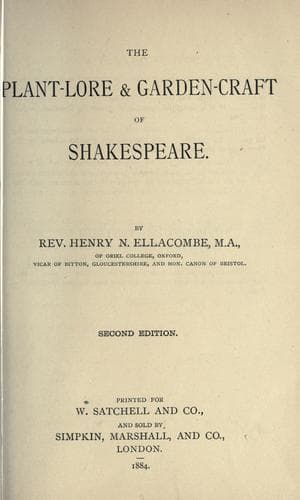
The plant-lore & garden-craft of ShakespeareEllacombe, Henry Nicholson
General
The plant-lore & garden-craft of Shakespeare
Ellacombe, Henry Nicholson
Gardens in literature; Plants in literature; Shakespeare, William, 1564-1616 -- Knowledge -- Botany
The garden Plums are a good cultivated variety of our own wild Sloe, but
a variety that did not originate in England, and may very probably have
been introduced by the Romans. The Sloe and Bullace are, speaking
botanically, two sub-species of Prunus communis, while the Plum is a
third sub-species (P. communis domestica). The garden Plum is
occasionally found wild in England, but is certainly not indigenous. It
is somewhat strange that our wild plant is not mentioned by Shakespeare
under any of its well-known names of Sloe, Bullace, and Blackthorn. Not
only is it a shrub of very marked appearance in our hedgerows in early
spring, when it is covered with its pure white blossoms, but Blackthorn
staves were indispensable in the rough game of quarterstaff, and the
Sloe gave point to more than one English proverb: "as black as a Sloe,"
was a very common comparison, and "as useless as a Sloe," or "not worth
a Sloe," was as common.
"Sir Amys answered, 'Tho'
I give thee thereof not one Sloe!
Do right all that thou may!"
_Amys and Amylion_--ELLIS'S _Romances_.
"The offecial seyde, Thys ys nowth
Be God, that me der bowthe,
Het ys not worthe a Sclo."
_The Frere and His Boy_--RITSON'S _Ancient Popular Poetry_.
Though even as a fruit the Sloe had its value, and was not altogether
despised by our ancestors, for thus Tusser advises--
"By thend of October go gather up Sloes,
Have thou in readines plentie of thoes,
And keepe them in bed-straw, or still on the bow,
To staie both the flix of thyselfe and thy cow."
As soon as the garden Plum was introduced, great attention seems to have
been paid to it, and the gardeners of Shakespeare's time could probably
show as good Plums as we can now. "To write of Plums particularly," said
Gerard, "would require a peculiar volume. . . . Every clymate hath his
owne fruite, far different from that of other countries; my selfe have
threescore sorts in my garden, and all strange and rare; there be in
other places many more common, and yet yearly commeth to our hands
others not before knowne."
FOOTNOTES:
[217:1] Omitted in the Globe edition.
[217:2] Bullein, in his "Government of Health," 1588, calls them
"Damaske Prunes."
POMEGRANATE.
(1) _Lafeu._
Go to, sir, you were beaten in Italy for picking a kernel out
of a Pomegranate.
_All's Well that Ends Well_, act ii, sc. 3 (275).
(2) _Juliet._
It was the nightingale and not the lark,
That pierced the fearful hollow of thine ear;
Nightly she sings on yon Pomegranate tree.[219:1]
_Romeo and Juliet_, act iii, sc. 5 (2).
(3) _Francis._
Anon, anon, sir, Look down into the Pomegarnet, Ralph.
_1st Henry IV_, act ii, sc. 4 (41).
Public-domain text, read in full here on John Shaqi.
Reviews
Reviews
No reviews yet
Be the first to share your thoughts on this work.
Elsewhere in the archive
Join the Discussion
Join the discussion
Sign in to leave a comment or review.
Sign InorCreate an account