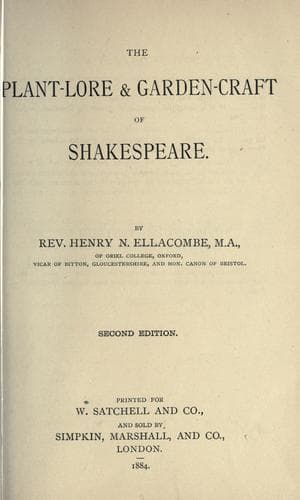
The plant-lore & garden-craft of ShakespeareEllacombe, Henry Nicholson
General
The plant-lore & garden-craft of Shakespeare
Ellacombe, Henry Nicholson
Gardens in literature; Plants in literature; Shakespeare, William, 1564-1616 -- Knowledge -- Botany
There are few trees that surpass the Pomegranate in interest and beauty
combined. "Whoever has seen the Pomegranate in a favourable soil and
climate, whether as a single shrub or grouped many together, has seen
one of the most beautiful of green trees; its spiry shape and
thick-tufted foliage of vigorous green, each growing shoot shaded into
tenderer verdure and bordered with crimson and adorned with the
loveliest flowers; filmy petals of scarlet lustre are put forth from the
solid crimson cup, and the ripe fruit of richest hue and most admirable
shape."--LADY CALCOTT'S _Scripture Herbal_. A simpler but more valued
testimony to the beauty of the Pomegranate is borne in its selection for
the choicest ornaments on the ark of the Tabernacle, on the priest's
vestments, and on the rich capitals of the pillars in the Temple of
Solomon.
The native home of the Pomegranate is not very certainly known, but the
evidence chiefly points to the North of Africa. It was very early
cultivated in Egypt, and was one of the Egyptian delicacies so fondly
remembered by the Israelites in their desert wanderings, and is
frequently met with in Egyptian sculpture. It was abundant in Palestine,
and is often mentioned in the Bible, and always as an object of beauty
and desire. It was highly appreciated by the Greeks and Romans, but it
was probably not introduced into Italy in very early times, as Pliny is
the first author that certainly mentions it, though some critics have
supposed that the _aurea mala_ and _aurea poma_ of Virgil and Ovid were
Pomegranates. From Italy the tree soon spread into other parts of
Europe, taking with it its Roman name of _Punica malus_ or _Pomum
granatum_. _Punica_ showed the country from which the Romans derived it,
while _granatum_ (full of grains) marked the special characteristic of
the fruit that distinguished it from all other so-called Apples. Gerard
says: "Pomegranates grow in hot countries, towards the south in Italy,
Spaine, and chiefly in the kingdom of Granada, which is thought to be so
named of the great multitude of Pomegranates, which be commonly called
_Granata_."[220:1] This derivation is very doubtful, but was commonly
accepted in Gerard's day.[220:2] The Pomegranate lives and flowers well
in England, but when it was first introduced is not recorded. I do not
find it in the old vocabularies, but a prominent place is given to it in
"that Gardeyn, wele wrought," "the garden that so lyked me;"--
"There were, and that I wote fulle well,
Of Pomgarnettys a fulle gret delle,
That is a fruit fulle welle to lyke,
Namely to folk whaune they ben sike."
_Romaunt of the Rose._
Turner describes it in 1548: "Pomegranat trees growe plentuously in
Italy and in Spayne, and there are certayne in my Lorde's gardene at
Syon, but their fruite cometh never with perfection."[221:1]
Public-domain text, read in full here on John Shaqi.
Reviews
Reviews
No reviews yet
Be the first to share your thoughts on this work.
Elsewhere in the archive
Join the Discussion
Join the discussion
Sign in to leave a comment or review.
Sign InorCreate an account