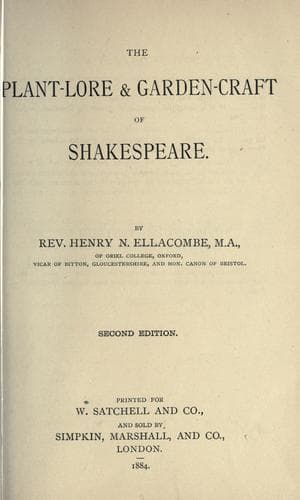
The plant-lore & garden-craft of ShakespeareEllacombe, Henry Nicholson
General
The plant-lore & garden-craft of Shakespeare
Ellacombe, Henry Nicholson
Gardens in literature; Plants in literature; Shakespeare, William, 1564-1616 -- Knowledge -- Botany
But it is time to come from the name to the flower. The English Primrose
is one of a large family of more than fifty species, represented in
England by the Primrose, the Oxlip, the Cowslip, and the Bird's-eye
Primrose of the North of England and Scotland. All the members of the
family, whether British or exotic, are noted for the simple beauty of
their flowers, but in this special character there is none that
surpasses our own. "It is the very flower of delicacy and refinement;
not that it shrinks from our notice, for few plants are more easily
seen, coming as it does when there is a dearth of flowers, when the
first birds are singing, and the first bees humming, and the earliest
green putting forth in the March and April woods; and it is one of those
plants which dislikes to be looking cheerless, but keeps up a
smouldering fire of blossom from the very opening of the year, if the
weather will permit."--FORBES WATSON. It is this character of
cheerfulness that so much endears the flower to us; as it brightens up
our hedgerows after the dulness of winter, the harbinger of many
brighter perhaps, but not more acceptable, beauties to come, it is the
very emblem of cheerfulness. Yet it is very curious to note what
entirely different ideas it suggested to our forefathers. To them the
Primrose seems always to have brought associations of sadness, or even
worse than sadness, for the "Primrose paths" and "Primrose ways" of Nos.
6 and 7 are meant to be suggestive of pleasures, but sinful pleasures.
Spenser associates it with death in some beautiful lines, in which a
husband laments the loss of a young and beautiful wife--
"Mine was the Primerose in the lowly shade!
* * * * *
Oh! that so fair a flower so soon should fade,
And through untimely tempest fade away."
_Daphnidia_, 232.
In another place he speaks of it as "the Primrose trew"--_Prothalamion_;
but in another place his only epithet for it is "green," which quite
ignores its brightness--
"And Primroses greene
Embellish the sweete Violet."
_Shepherd's Calendar--April._
Shakespeare has no more pleasant epithets for our favourite flower than
"pale," "faint," "that die unmarried;" and Milton follows in the same
strain yet sadder. Once, indeed, he speaks of youth as "Brisk as the
April buds in Primrose season" ("Comus"); but only in three passages
does he speak of the Primrose itself, and in two of these he connects it
with death--
"Bring the rathe Primrose that forsaken dies,
* * * * *
And every flower that sad embroidery wears."--_Lycidas._
"O fairest flower, no sooner blown but blasted,
Soft silken Primrose fading timelesslie;
Summer's chief honour, if thou hadst outlasted
Bleak winter's force that made thy blossoms drie."
Public-domain text, read in full here on John Shaqi.
Reviews
Reviews
No reviews yet
Be the first to share your thoughts on this work.
Elsewhere in the archive
Join the Discussion
Join the discussion
Sign in to leave a comment or review.
Sign InorCreate an account