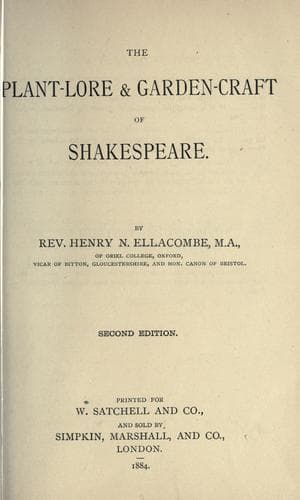
The plant-lore & garden-craft of ShakespeareEllacombe, Henry Nicholson
General
The plant-lore & garden-craft of Shakespeare
Ellacombe, Henry Nicholson
Gardens in literature; Plants in literature; Shakespeare, William, 1564-1616 -- Knowledge -- Botany
_Winter's Tale_, act iv, sc. 4 (73).
(2) _Bawd._
Marry, come up, my dish of chastity with Rosemary and bays.
_Pericles_, act iv, sc. 6 (159).
(3) _Edgar._
Bedlam beggars, who, with roaring voices
Strike in their numb'd and mortified bare arms
Pins, wooden pricks, and sprigs of Rosemary.
_Lear_, act ii, sc. 3 (14).
(4) _Ophelia._
There's Rosemary, that's for remembrance; pray, love, remember.
_Hamlet_, act iv, sc. 5 (175).
(5) _Nurse._
Doth not Rosemary and Romeo begin both with a letter?
_Romeo._
Ay, nurse; what of that? both with an R.
_Nurse._
Ah, mocker! that's the dog's name; R is for the ----.
No; I know it begins with some other
letter:--and she hath the prettiest sententious
of it, of you and Rosemary, that it would do you
good to hear it.
_Romeo and Juliet_, act ii, sc. 4 (219).
(6) _Friar._
Dry up your tears, and stick your Rosemary
On this fair corse.
_Ibid._, act iv, sc. 5 (79).
The Rosemary is not a native of Britain, but of the sea-coast of the
South of Europe, where it is very abundant. It was very early introduced
into England, and is mentioned in an Anglo-Saxon Herbarium under its
Latin name of Ros marinus, and is there translated by Bothen, _i.e._
Thyme; also in an Anglo-Saxon Vocabulary of the eleventh century, where
it is translated Feld-madder and Sun-dew. In these places our present
plant may or may not be meant, but there is no doubt that it is the one
referred to in an ancient English poem of the fourteenth century, on the
virtues of herbs, published in Wright and Halliwell's "Reliquiæ
Antiquæ." The account of "The Gloriouse Rosemaryne" is long, but the
beginning and ending are worth quoting--
"This herbe is callit Rosemaryn
Of vertu that is gode and fyne;
But alle the vertues tell I ne cane,
No I trawe no erthely man.
* * * * *
Of thys herbe telles Galiene
That in hys contree was a quene,
Gowtus and Crokyt as he hath tolde,
And eke sexty yere olde;
Sor and febyl, where men hyr sey
Scho semyth wel for to dey;
Of Rosmaryn scho toke sex pow̄de,
And grownde hyt wel in a stownde,
And bathed hir threyes everi day,
Nine mowthes, as I herde say,
And afterwarde anoynitte wel hyr hede
With good bame as I rede;
Away fel alle that olde flessche,
And yow̄ge i-sprong tender and nessche;
So fresshe to be scho then began
Scho coveytede couplede be to man." (Vol. i, 196).
Public-domain text, read in full here on John Shaqi.
Reviews
Reviews
No reviews yet
Be the first to share your thoughts on this work.
Elsewhere in the archive
Join the Discussion
Join the discussion
Sign in to leave a comment or review.
Sign InorCreate an account