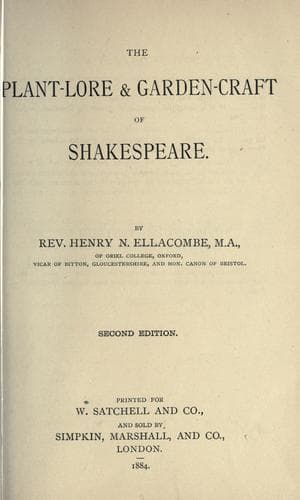
The plant-lore & garden-craft of ShakespeareEllacombe, Henry Nicholson
General
The plant-lore & garden-craft of Shakespeare
Ellacombe, Henry Nicholson
Gardens in literature; Plants in literature; Shakespeare, William, 1564-1616 -- Knowledge -- Botany
We can now scarcely understand the high favour in which Rosemary was
formerly held; we are accustomed to see it neglected, or only tolerated
in some corner of the kitchen garden, and not often tolerated there. But
it was very different in Shakespeare's time, when it was in high favour
for its evergreen leaves and fine aromatic scent, remaining a long time
after picking, so long, indeed, that both leaves and scent were almost
considered everlasting. This was its great charm, and so Spenser spoke
of it as "the cheerful Rosemarie" and "refreshing Rosemarine," and good
Sir Thomas More had a great affection for it. "As for Rosemarine," he
said, "I lett it run alle over my garden walls, not onlie because my
bees love it, but because tis the herb sacred to remembrance, and
therefore to friendship; whence a sprig of it hath a dumb language that
maketh it the chosen emblem at our funeral wakes and in our buriall
grounds." And Parkinson gives a similar account of its popularity as a
garden plant: "Being in every woman's garden, it were sufficient but to
name it as an ornament among other sweet herbs and flowers in our
gardens. In this our land, where it hath been planted in noblemen's and
great men's gardens against brick walls, and there continued long, it
riseth up in time unto a very great height, with a great and woody stem
of that compasse that, being cloven out into boards, it hath served to
make lutes or such like instruments, and here with us carpenters' rules
and to divers others purposes." It was the favourite evergreen wherever
the occasion required an emblem of constancy and perpetual remembrance,
such especially as weddings and funerals, at both of which it was
largely used; and so says Herrick of "The Rosemarie Branch"--
"Grow for two ends, it matters not at all,
Be't for my bridall or my buriall."
Its use at funerals was very widespread, for Laurembergius records a
pretty custom in use in his day, 1631, at Frankfort: "Is mos apud nos
retinetur, dum cupresso humile, vel rore marino, non solum coronamus
funera jamjam ducenda, sed et iis appendimus ex iisdem herbis litteras
collectas, significatrices nominis ejus quæ defuncta est. Nam in
puellarum funeribus hæc fere fieri solent" ("Horticulturæ," cap. vj.).
Its use at weddings is pleasantly told in the old ballad of "The Bride's
Good-morrow"--
"The house is drest and garnisht for your sake
With flowers gallant and green;
A solemn feast your comely cooks do ready make,
Where all your friends will be seen:
Young men and maids do ready stand
With sweet Rosemary in their hand--
A perfect token of your virgin's life.
To wait upon you they intend
Unto the church to make an end:
And God make thee a joyfull wedded wife."
_Roxburghe Ballads_, vol. i.
Public-domain text, read in full here on John Shaqi.
Reviews
Reviews
No reviews yet
Be the first to share your thoughts on this work.
Elsewhere in the archive
Join the Discussion
Join the discussion
Sign in to leave a comment or review.
Sign InorCreate an account