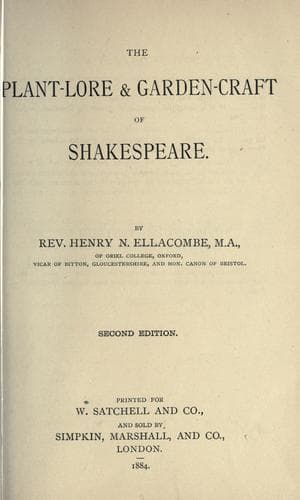
The plant-lore & garden-craft of ShakespeareEllacombe, Henry Nicholson
General
The plant-lore & garden-craft of Shakespeare
Ellacombe, Henry Nicholson
Gardens in literature; Plants in literature; Shakespeare, William, 1564-1616 -- Knowledge -- Botany
"To nobler sights
Michael from Adam's eyes the filme removed
Which that false fruit which promised clearer sight
Had bred; then purged with Euphrasie and Rue
The visual nerve, for he had much to see:"
_Paradise Lost_, book xi.;
and which was more fully stated in the old lines of the Schola Salerni--
"Nobilis est Ruta quia lumina reddit acuta;
Auxilio rutæ, vir lippe, videbis acute;
Cruda comesta recens oculos Caligine purgat;
Ruta facit castum, dat lumen, et ingerit astum;
Cocta facit Ruta et de pollicibus loca tuta."
After reading this high moral and physical character of the herb, it is
rather startling to find that "It is believed that if stolen from a
neighbour's garden it would prosper better." It was, however, an old
belief--
"They sayen eke stolen sede is butt the bette."
_Palladius on Husbandrie_ (c. 1420) iv, 269.
"It is a common received opinion that Rue will grow the better if it
bee filtched out of another man's garden."--HOLLAND'S _Pliny_, xix. 7.
As other medicines were introduced the Rue declined in favour, so that
Parkinson spoke of it with qualified praise--"Without doubt it is a most
wholesom herb, although bitter and strong. Some do rip up a bead-rowl of
the virtues of Rue, . . . but beware of the too-frequent or overmuch use
therof." And Dr. Daubeny says of it, "It is a powerful stimulant and
narcotic, but not much used in modern practise."
As a garden plant, the Rue forms a pretty shrub for a rock-work, if
somewhat attended to, so as to prevent its becoming straggling and
untidy. The delicate green and peculiar shape of the leaves give it a
distinctive character, which forms a good contrast to other plants.
FOOTNOTES:
[260:1]
"Rewe on my child, that of thyn gentilnesse
Rewest on every sinful in destresse."
CHAUCER, _The Man of Lawes Tale_.
[261:1] "Ranke-smelling Rue."--SPENSER, _Muiopotmos_.
RUSH.
(1) _Rosalind._
He taught me how to know a man in love; in which cage of
Rushes I am sure you are not prisoner.
_As You Like It_, act iii, sc. 2 (388).
(2) _Phœbe._
Lean but on a Rush,
The cicatrice and capable impressure
Thy palm some moment keeps.
_Ibid._, act iii, sc. 5 (22).
(3) _Clown._
As fit as Tib's Rush for Tom's forefinger.
_All's Well that Ends Well_, act ii, sc. 2 (24).
(4) _Romeo._
Let wantons light of heart
Tickle the senseless Rushes with their heels.
_Romeo and Juliet_, act i, sc. 4 (35).
(5) _Dromio of Syracuse._
Some devils ask but the parings of one's nail,
A Rush, a hair, a drop of blood, a pin,
A Nut, a Cherry-stone.
Public-domain text, read in full here on John Shaqi.
Reviews
Reviews
No reviews yet
Be the first to share your thoughts on this work.
Elsewhere in the archive
Join the Discussion
Join the discussion
Sign in to leave a comment or review.
Sign InorCreate an account