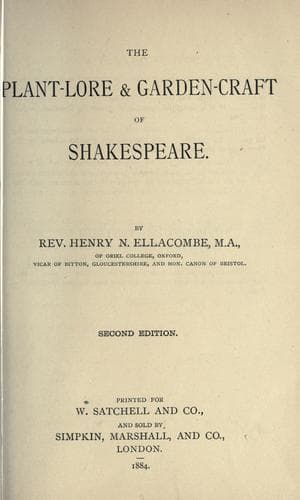
The plant-lore & garden-craft of ShakespeareEllacombe, Henry Nicholson
General
The plant-lore & garden-craft of Shakespeare
Ellacombe, Henry Nicholson
Gardens in literature; Plants in literature; Shakespeare, William, 1564-1616 -- Knowledge -- Botany
Indeed, sir, she was the Sweet Marjoram of the salad, or
rather the Herb of Grace.
_Lafeu._
They are not salad-herbs, you knave, they are nose-herbs.
_All's Well that Ends Well_, act iv, sc. 5 (17).
Comparing (2) and (3) together, there is little doubt that the same herb
is alluded to in both; and it is, perhaps, alluded to, though not
exactly named, in the following:
_Friar Laurence._
In man, as well as herbs, grace and rude will.
_Romeo and Juliet_, act ii, sc. 3 (28).
Shakespeare thus gives us the two names for the same plant, Rue and Herb
of Grace, and though at first sight there seems to be little or no
connection between the two names, yet really they are so closely
connected, that the one name was derived from, or rather suggested by,
the other. Rue is the English form of the Greek and Latin _ruta_, a word
which has never been explained, and in its earlier English form of
_rude_ came still nearer to the Latin original. But _ruth_ was the
English word for sorrow and remorse, and _to rue_ was to be sorry for
anything, or to have pity;[260:1] we still say a man will rue a
particular action, _i.e._, be sorry for it; and so it was a natural
thing to say that a plant which was so bitter, and had always borne the
name _Rue_ or _Ruth_, must be connected with repentance. It was,
therefore, the Herb of Repentance, and this was soon transformed into
the Herb of Grace (in 1838 Loudon said, "It is to this day called Ave
Grace in Sussex"), repentance being the chief sign of grace; and it is
not unlikely that this idea was strengthened by the connection of Rue
with the bitter herbs of the Bible, though it is only once mentioned,
and then with no special remark, except as a tithable garden herb,
together with Anise and Cummin.
The Rue, like Lavender and Rosemary, is a native of the more barren
parts of the coasts of the Mediterranean, and has been found on Mount
Tabor, but it was one of the earliest occupants of the English Herb
garden. It is very frequently mentioned in the Saxon Leech Books, and
entered so largely into their prescriptions that it must have been very
extensively grown. Its strong aromatic smell,[261:1] and bitter taste,
with the blistering quality of the leaves, soon established its
character as almost a heal-all.
"Rew bitter a worthy gres (herb)
Mekyl of myth and vertu is."
_Stockholm MS._, 1305.
Even beasts were supposed to have discovered its virtues, so that
weasels were gravely said, and this by such men as Pliny, to eat Rue
when they were preparing themselves for a fight with rats and serpents.
Its especial virtue was an eye-salve, a use which Milton did not
overlook--
Public-domain text, read in full here on John Shaqi.
Reviews
Reviews
No reviews yet
Be the first to share your thoughts on this work.
Elsewhere in the archive
Join the Discussion
Join the discussion
Sign in to leave a comment or review.
Sign InorCreate an account