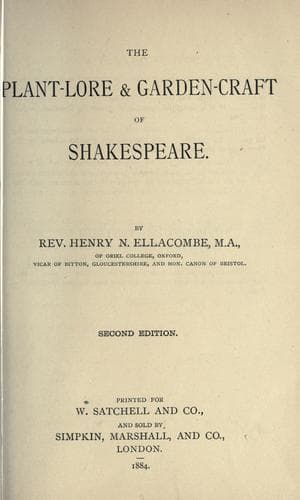
The plant-lore & garden-craft of ShakespeareEllacombe, Henry Nicholson
General
The plant-lore & garden-craft of Shakespeare
Ellacombe, Henry Nicholson
Gardens in literature; Plants in literature; Shakespeare, William, 1564-1616 -- Knowledge -- Botany
The Common Rush, though the mark of badly cultivated ground, and the
emblem of uselessness, was not without its uses, some of which are
referred to in Nos. 1, 3, and 11. In Nos. 3 and 18 reference is made to
the Rush-ring, a ring, no doubt, originally meant and used for the
purposes of honest betrothal, but afterwards so vilely used for the
purposes of mock marriages, that even as early as 1217 Richard Bishop of
Salisbury had to issue his edict against the use of "annulum de junco."
The Rush betrothal ring is mentioned by Spenser--
"O thou great shepheard, Lobbin, how great is thy griefe!
Where bene the nosegayes that she dight for thee?
The coloured chaplets wrought with a chiefe,
The knotted Rush-ringes and gilt Rosemarie."
_Shepherd's Calendar--November._
And by Quarles--
"Love-sick swains
Compose Rush-rings, and Myrtle-berry chains,
And stuck with glorious King-cups in their bonnets,
Adorned with Laurel slip, chant true love sonnets."
But the uses of the Rush were not all bad. Newton, in 1587, said of the
Rush--"It is a round smooth shoote without joints or knots, having
within it a white substance or pith, which being drawn forth showeth
like long white, soft, gentle, and round thread, and serveth for many
purposes. Heerewith be made manie pretie imagined devises for Bride-ales
and other solemnities, as little baskets, hampers, frames, pitchers,
dishes, combs, brushes, stooles, chaires, purses with strings, girdles,
and manie such other pretie and curious and artificiall conceits, which
at such times many do take the paines to make and hang up in their
houses, as tokens of good will to the new married Bride; and after the
solemnities ended, to bestow abroad for Bride-gifts or presents." It was
this "white substance or pith" from which the Rush candle (No. 11) was
and still is made: a candle which in early days was probably the
universal candle, which, till within a few years, was the night candle
of every sick chamber, in which most of us can recollect it as a most
ghastly object as it used to stand, "stationed in a basin on the floor,
where it glimmered away like a gigantic lighthouse in a particularly
small piece of water" (Pickwick), till expelled by the night-lights, and
which is still made by Welsh labourers, and, I suppose, in Shakespeare's
time was the only candle used by the poor.
"If your influence be quite damm'd up
With black usurping mists, some gentle taper,
Though a Rush-candle from the wicker hole
Of some clay habitation, visit us
With thy long levell'd rule of streaming light."--_Comus._
Public-domain text, read in full here on John Shaqi.
Reviews
Reviews
No reviews yet
Be the first to share your thoughts on this work.
Elsewhere in the archive
Join the Discussion
Join the discussion
Sign in to leave a comment or review.
Sign InorCreate an account