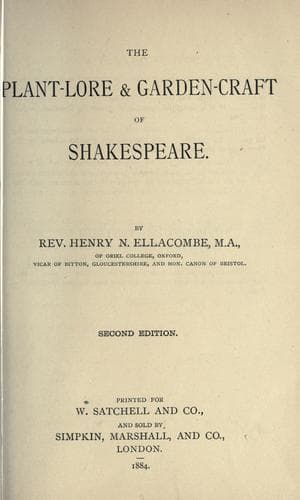
The plant-lore & garden-craft of ShakespeareEllacombe, Henry Nicholson
General
The plant-lore & garden-craft of Shakespeare
Ellacombe, Henry Nicholson
Gardens in literature; Plants in literature; Shakespeare, William, 1564-1616 -- Knowledge -- Botany
But the chief use of Rushes in those days was to strew the floors of
houses and churches (Nos. 4, 7, 10, 12, and 14). This custom seems to
have been universal in all houses of any pretence. "William the son of
William of Alesbury holds three roods of land of the Lord the King in
Alesbury in Com. Buck by the service of finding straw for the bed of the
Lord the King, and to strew his chamber, and also of finding for the
King when he comes to Alesbury straw for his bed, and besides this Grass
or Rushes to make his chamber pleasant."--BLUNT'S _Tenures_. The custom
went on even to our own day in Norwich Cathedral, and the "picturesque
custom still lingers in the West of strewing the floors of the churches
on Whit Sunday with Rushes freshly pulled from the meadows. This custom
attains its highest perfection in the church of St. Mary Redcliffe at
Bristol. On 'Rush Sunday' the floor is strewn with Rushes. All the
merchants throw open their conservatories for the vicar to take his
choice of their flowers, and the pulpit, the lectern, the choir, and the
communion rails and table present a scene of great beauty."--_The
Garden_, May, 1877.
For this purpose the Sweet-scented Rush was always used where it could
be procured, and when first laid down it must have made a pleasant
carpet; but it was a sadly dirty arrangement, and gives us a very poor
idea of the cleanliness of even the best houses, though it probably was
not the custom all through the year, as Newton says, speaking of Sedges,
but evidently confusing the Sedge with the Sweet-scented Rush, "with the
which many in this countrie do use in sommer time to straw their
parlours and churches, as well for cooleness as for pleasant
smell."[266:1] This Rush (_Acorus calamus_) is a British plant, with
broad leaves, which have a strong cinnamon-like smell, which obtained
for the plant the old Saxon name of Beewort. Another (so-called) Rush,
the Flowering Rush (_Butomus umbellatus_), is one of the very handsomest
of the British plants, bearing on a long straight stem a large umbel of
very handsome pink flowers. Wherever there is a pond in a garden, these
fine Rushes should have a place, though they may be grown in the open
border where the ground is not too dry.
Public-domain text, read in full here on John Shaqi.
Reviews
Reviews
No reviews yet
Be the first to share your thoughts on this work.
Elsewhere in the archive
Join the Discussion
Join the discussion
Sign in to leave a comment or review.
Sign InorCreate an account