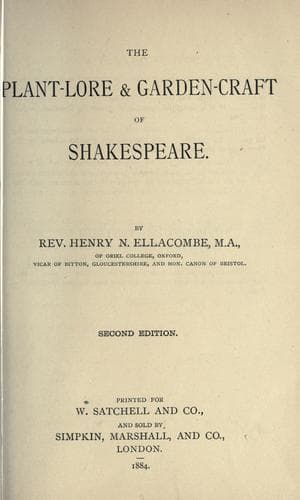
The plant-lore & garden-craft of ShakespeareEllacombe, Henry Nicholson
General
The plant-lore & garden-craft of Shakespeare
Ellacombe, Henry Nicholson
Gardens in literature; Plants in literature; Shakespeare, William, 1564-1616 -- Knowledge -- Botany
There is a story told by Sir John Mandeville in connection with Rushes
which is not easy to understand. According to his account, our Saviour's
crown of thorns was made of Rushes! "And zif alle it be so that men seyn
that this Croune is of Thornes, zee shall undirstande that it was of
Jonkes of the See, that is to sey, Russhes of the See, that prykken als
scharpely as Thornes. For I have seen and beholden many times that of
Parys and that of Constantynoble, for thei were bothe on, made of
Russches of the See. But men have departed hem in two parties, of the
which on part is at Parys, and the other part is at Constantynoble--and
I have on of the precyouse Thornes, that semethe licke a white Thorn,
and that was zoven to me for great specyaltee. . . . The Jewes setten
him in a chayere and clad him in a mantelle, and then made thei the
Croune of Jonkes of the See."--_Voiage and Travaile,_ c. 2.
I have no certainty to what Rush the pleasant old traveller can here
refer. I can only guess that as Rushes and Sedges were almost
interchangeable names, he may have meant the Sea Holly, formerly called
the Holly-sedge, of which there is a very appropriate account given in
an old Saxon runelay thus translated by Cockayne: "Hollysedge hath its
dwelling oftenest in a marsh, it waxeth in water, woundeth fearfully,
burneth with blood (_i.e._, draws blood and pains) every one of men who
to it offers any handling."[267:1]
FOOTNOTES:
[264:1]
"Around the islet at its lowest edge,
Lo, there beneath, where breaks th' encircling wave,
The yielding mud is thick with Rushes crowned.
No other flower with frond or leafy growth
Or hardened fibre there can life sustain,
For none bend safely to the watery shock."
DANTE, _Purgatorio_, canto i. (Johnston).
[266:1] "In the South of Europe Juniper branches were used for this
purpose, as they still are in Sweden."--_Flora Domestica_, p. 213.
"As I have seen upon a bridal day,
Full many maids clad in their best array,
In honour of the bride, come with their flaskets
Filled full of flowers, other in wicker baskets
Bring from the Marish Rushes, to overspread
The ground whereon to Church the lovers tread."
BROWNE'S _Brit. Past._, i, 2.
[267:1] I leave this as I first wrote it, but I have to thank Mr.
Britten for the very probable suggestion that Sir John Mandeville was
right. Not only does the _Juncus acutus_ "prykken als scharpely as
Thornes," but "what is shown in Paris at the present day as the crown of
Thorns is certainly, as Sir John says, made of rushes; the curious may
consult M. Rohault de Fleury's sumptuous 'Mémoire sur les Instruments de
la Passion,' for a full description of it."
RYE.
(1) _Iris._
Ceres, most bounteous lady, thy rich leas
Of Wheat, Rye, Barley, Vetches, Oats, and Pease.
Public-domain text, read in full here on John Shaqi.
Reviews
Reviews
No reviews yet
Be the first to share your thoughts on this work.
Elsewhere in the archive
Join the Discussion
Join the discussion
Sign in to leave a comment or review.
Sign InorCreate an account