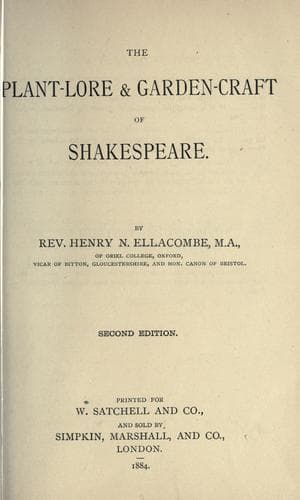
The plant-lore & garden-craft of ShakespeareEllacombe, Henry Nicholson
General
The plant-lore & garden-craft of Shakespeare
Ellacombe, Henry Nicholson
Gardens in literature; Plants in literature; Shakespeare, William, 1564-1616 -- Knowledge -- Botany
Though the chief fame of the Saffron Crocus is as a field plant, yet it
is also a very handsome flower; but it is a most capricious one, which
may account for the area of cultivation being so limited. In some places
it entirely refuses to flower, as it does in my own garden, where I have
cultivated it for many years but never saw a flower, while in a
neighbour's garden, under apparently the very same conditions of soil
and climate, it flowers every autumn. But if we cannot succeed with the
Saffron Crocus, there are many other Croci which were known in the time
of Shakespeare, and grown not "for any other use than in regard of
their beautiful flowers of several varieties, as they have been
carefully sought out and preserved by divers to furnish a garden of
dainty curiosity." Gerard had in his garden only six species; Parkinson
had or described thirty-one different sorts, and after his time new
kinds were not so much sought after till Dean Herbert collected and
studied them. His monograph of the Crocus, in 1847, contained the
account of forty-one species, besides many varieties. The latest
arrangement of the family by Mr. George Maw, of Broseley, contains
sixty-eight species, besides varieties; of these all are not yet in
cultivation, but every year sees some fresh addition to the number,
chiefly by the unwearied exertions in finding them in their native
habitats, and the liberal distribution of them when found, of Mr. Maw,
to whom all the lovers of the Crocus are deeply indebted. And the Croci
are so beautiful that we cannot have too many of them; they are, for the
most part, perfectly hardy, though some few require a little protection
in winter; they are of an infinite variety of colour, and some flower in
the spring and some in the autumn. Most of us call the Crocus a spring
flower, yet there are more autumnal than vernal species, but it is as a
spring flower that we most value it. The common yellow Crocus is almost
as much "the first-born of the year's delight" as the Snowdrop. No one
can tell its native country, but it has been the brightest ornament of
our gardens, not only in spring, but even in winter, for many years. It
was probably first introduced during Shakespeare's life. "It hath
floures," says Gerard, "of a most perfect shining yellow colour, seeming
afar off to be a hot glowing coal of fire. That pleasant plant was sent
unto me from Robinus, of Paris, that painful and most curious searcher
of simples." From that beginning perhaps it has found its way into every
garden, for it increases rapidly, is very hardy, and its brightness
commends it to all. It is the "most gladsome of the early flowers. None
gives more glowing welcome to the season, or strikes on our first
glance with a ray of keener pleasure, when, with some bright morning's
warmth, the solitary golden fringes have kindled into knots of
thick-clustered yellow bloom on the borders of the cottage garden. At a
Public-domain text, read in full here on John Shaqi.
Reviews
Reviews
No reviews yet
Be the first to share your thoughts on this work.
Elsewhere in the archive
Join the Discussion
Join the discussion
Sign in to leave a comment or review.
Sign InorCreate an account