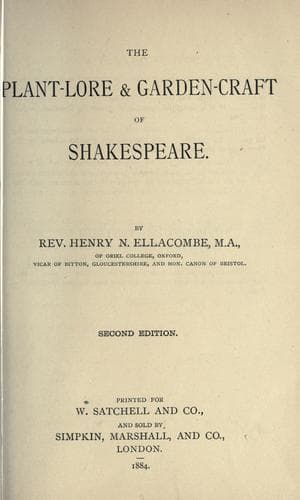
The plant-lore & garden-craft of ShakespeareEllacombe, Henry Nicholson
General
The plant-lore & garden-craft of Shakespeare
Ellacombe, Henry Nicholson
Gardens in literature; Plants in literature; Shakespeare, William, 1564-1616 -- Knowledge -- Botany
distance the eye is caught by that glowing patch, its warm heart open to
the sun, and dear to the honey-gathering bees which hum around the
chalices."--FORBES WATSON.
With this pretty picture I may well close the account of the Crocus, but
not because the subject is exhausted, for it is very tempting to go much
further, and to speak of the beauties of the many species, and of the
endless forms and colours of the grand Dutch varieties; and whatever
admiration may be expressed for the common yellow Dutch Crocus, the same
I would also give to almost every member of this lovely and cheerful
family.
FOOTNOTES:
[268:1] Fuller says of the crocodile--"He hath his name of χροχό-δειλος,
or the Saffron-fearer, knowing himself to be all poison, and it all
antidote."--_Worthies of England_, i, 336, ed. 1811.
[270:1] "Cilician," or "Corycean," were the established classical
epithets to use when speaking of the Saffron. Cowley quotes--
"Corycii pressura Croci"--LUCAN;
"Ultima Corycio quæ cadit aura Croco"--MARTIAL;
and adds the note--"Omnes Poetæ hoc quasi solenni quodam Epitheto
utuntur. Corycus nomen urbis et montis in Cilicia, ubi laudatissimus
Crocus nascebatur."--_Plantarum_, lib. i, 49.
[270:2] "Saffron is . . . a native of Cashmere, . . . and the . . .
Saffron Crocus and the Hemp plant have followed their (the Aryans)
migrations together throughout the temperate zone of the
globe."--BIRDWOOD, _Handbook to the Indian Court_, p. 23.
[271:1] "Our English hony and Safron is better than any that commeth
from any strange or foregn land."--BULLEIN, _Government of Health_,
1588.
[271:2] The arms of the borough of Saffron Walden are "three Saffron
flowers walled in."
SAMPHIRE.
_Edgar._
Half-way down
Hangs one that gathers Samphire, dreadful trade!
Methinks he seems no bigger than his head.
_King Lear_, act iv, sc. 6 (14).
Public-domain text, read in full here on John Shaqi.
Reviews
Reviews
No reviews yet
Be the first to share your thoughts on this work.
Elsewhere in the archive
Join the Discussion
Join the discussion
Sign in to leave a comment or review.
Sign InorCreate an account