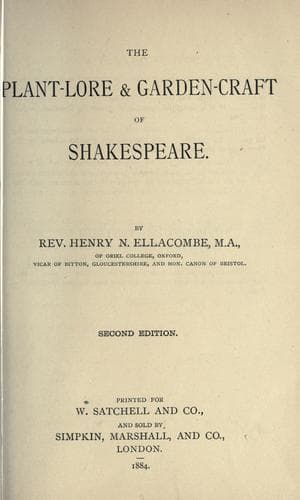
The plant-lore & garden-craft of ShakespeareEllacombe, Henry Nicholson
General
The plant-lore & garden-craft of Shakespeare
Ellacombe, Henry Nicholson
Gardens in literature; Plants in literature; Shakespeare, William, 1564-1616 -- Knowledge -- Botany
In this passage, Stover is probably the bent or dried Grass still
remaining on the land, but it is the common word for hay or straw, or
for "fodder and provision for all sorts of cattle; from _Estovers_, law
term, which is so explained in the law dictionaries. Both are derived
from _Estouvier_ in the old French, defined by Roquefort--'Convenance,
nécessité, provision de tout ce qui est nécessaire.'"--NARES. The word
is of frequent occurrence in the writers of the time of Shakespeare. One
quotation from Tusser will be sufficient--
"Keepe dry thy straw--
"If house-roome will serve thee, lay Stover up drie,
And everie sort by it selfe for to lie.
Or stack it for litter if roome be too poore,
And thatch out the residue, noieng thy door."
_November's Husbandry._
STRAWBERRY.
(1) _Iago._
Have you not sometimes seen a handkerchief
Spotted with Strawberries in your wife's hand?[279:1]
_Othello_, act iii, sc. 3 (434).
(2) _Ely._
The Strawberry grows underneath the Nettle,
And wholesome berries thrive and ripen best
Neighbour'd by fruit of baser quality;
And so the prince obscured his contemplation
Under the veil of wildness.
_Henry V_, act i, sc. 1 (60).
(3) _Gloster._
My Lord of Ely, when I was last in Holborn,
I saw good Strawberries in your garden there;
I do beseech you send for some of them.
_Ely._
Marry, and will, my Lord, with all my heart.
* * * * *
Where is my lord Protector? I have sent
For these Strawberries.
_King Richard III_, act iii, sc. 4 (32).
Public-domain text, read in full here on John Shaqi.
Reviews
Reviews
No reviews yet
Be the first to share your thoughts on this work.
Elsewhere in the archive
Join the Discussion
Join the discussion
Sign in to leave a comment or review.
Sign InorCreate an account