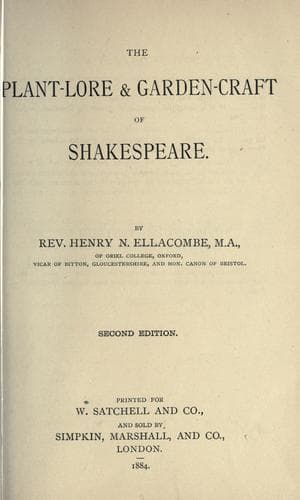
The plant-lore & garden-craft of ShakespeareEllacombe, Henry Nicholson
General
The plant-lore & garden-craft of Shakespeare
Ellacombe, Henry Nicholson
Gardens in literature; Plants in literature; Shakespeare, William, 1564-1616 -- Knowledge -- Botany
The Bishop of Ely's garden in Holborn must have been one of the chief
gardens of England in the fourteenth and fifteenth centuries, for this
is the third time it has been brought under our notice. It was
celebrated for its Roses (_see_ ROSE); it was so celebrated for its
Saffron Crocuses that part of it acquired the name which it still keeps,
Saffron Hill; and now we hear of its "good Strawberries;" while the
remembrance of "the ample garden," and of the handsome Lord Chancellor
to whom it was given when taken from the bishopric, is still kept alive
in its name of Hatton Garden. How very good our forefathers'
Strawberries were, we have a strong proof in old Isaak Walton's happy
words: "Indeed, my good scholar, we may say of angling as Dr. Boteler
said of Strawberries: 'Doubtless God could have made a better berry, but
doubtless God never did;' and so, if I might be judge, God never did
make a more calm, quiet, innocent recreation than angling." I doubt
whether, with our present experience of good Strawberries, we should
join in this high praise of the Strawberries of Shakespeare's or Isaak
Walton's day, for their varieties of Strawberry must have been very
limited in comparison to ours. Their chief Strawberry was the Wild
Strawberry brought straight from the woods, and no doubt much improved
in time by cultivation. Yet we learn from Spenser and from Tusser that
it was the custom to grow it just as it came from the woods.
Spenser says--
"One day as they all three together went
Into the wood to gather Strawberries."--_F. Q._, vi. 34;
and Tusser--
"Wife, into thy garden, and set me a plot
With Strawbery rootes of the best to be got:
Such growing abroade, among Thornes in the wood,
Wel chosen and picked, prove excellent good.
* * * * *
The Gooseberry, Respis, and Roses al three
With Strawberies under them trimly agree."
_September's Husbandry._
And even in the next century, Sir Hugh Plat said--
"Strawberries which grow in woods prosper best in gardens."
_Garden of Eden_, i, 20.[281:1]
Besides the wild one (_Fragaria vesca_), they had the Virginian (_F.
Virginiana_), a native of North America, and the parent of our scarlets;
but they do not seem to have had the Hautbois (_F. elatior_), or the
Chilian, or the Carolinas, from which most of our good varieties have
descended.
Public-domain text, read in full here on John Shaqi.
Reviews
Reviews
No reviews yet
Be the first to share your thoughts on this work.
Elsewhere in the archive
Join the Discussion
Join the discussion
Sign in to leave a comment or review.
Sign InorCreate an account